Restoring a Worn Muonionalusta Ring: A Real Workshop Case Study
Meteorite ring re-etching is sometimes needed when the etched pattern on a meteorite ring becomes difficult to see through normal wear. This article documents the restoration of a worn Muonionalusta meteorite ring with a tantalum liner, carried out in our workshop and photographed as the work progressed.
The images used throughout this article were taken on an iPhone during the restoration itself. They are workshop documentation images rather than studio photography, and that is intentional. They show the real condition of the ring at each stage, including cleaning, etching, neutralising and drying.
The objective was straightforward. Restore the visibility of the Widmanstätten pattern while preserving the satin character of the meteorite and maintaining the integrity of the bonded tantalum liner.
This project could also be described as a meteorite ring restoration. The aim was not to change the ring or alter its character. It was to restore the contrast in the natural pattern while keeping a finish suitable for regular wear.
The ring had become dull and grey through use. Traces of the pattern could still be seen, but the contrast that normally makes meteorite distinctive had largely faded.
What Was Being Restored?
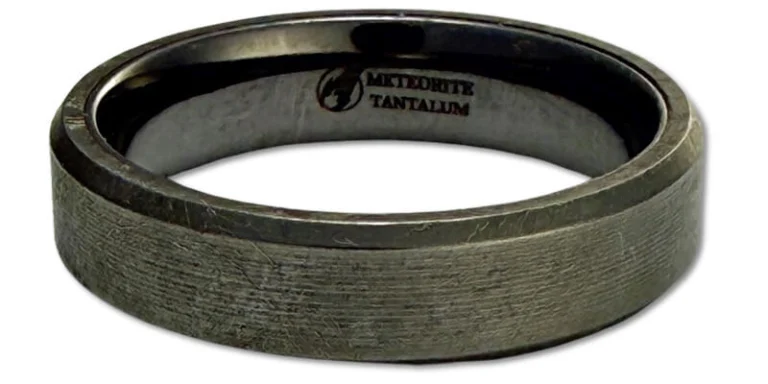
Worn Muonionalusta meteorite ring before re-etching.
The ring consisted of a Muonionalusta meteorite sleeve bonded to a tantalum comfort-fit liner. The join between the two materials was only visible from the side of the ring when viewed closely.
Although the meteorite surface had become visually flat, the tantalum liner remained in excellent condition and required no restoration work. This pairing of meteorite and tantalum is common because it combines the distinctive appearance of meteorite with the comfort and stability of tantalum.
The ring used in this case study is an example of bonded ring construction, where two different materials are combined to take advantage of the characteristics of each one. The meteorite provides the pattern and visual interest, while tantalum provides a stable and comfortable inner surface.
Similar designs can be found throughout our meteorite rings collection, while the liner material itself is featured throughout our tantalum rings range. If you would like to learn more about the metal, our tantalum ring guide explains its characteristics in greater detail.
The close-up image illustrates the problem clearly. The pattern had not disappeared, but the contrast had reduced to the point where the surface looked closer to plain grey metal than etched meteorite.
Why Meteorite Rings Lose Their Pattern
A meteorite ring loses its visible pattern because wear gradually smooths the surface and reduces the contrast between the crystal phases. The Widmanstätten structure itself does not disappear.
Muonionalusta is an iron meteorite composed primarily of iron and nickel. Its distinctive appearance comes from the Widmanstätten pattern, formed over millions of years as the parent asteroid cooled extremely slowly in space. Different iron-nickel alloys crystallised at different rates, creating the interlocking structures visible after etching.
The pattern remains present within the meteorite. What changes is the surface contrast that allows the eye to distinguish those structures.
Over time, daily handling, skin contact, fine scratches, oxidation and general smoothing of the surface gradually reduce that contrast. As the surface becomes more uniform, the pattern appears flatter and less defined.
Re-etching restores contrast by removing a microscopic amount of material from the surface. It does not add a design to the ring. It reveals the natural structure already present in the meteorite.
This is not unique to meteorite. Similar visual softening can occur in Damascus steel, although the reason is different because Damascus obtains its appearance from layered steel forged together during manufacture rather than a naturally occurring crystal structure.
For readers interested in the material itself, our meteorite ring guide explains the formation of Muonionalusta and the Widmanstätten pattern in greater detail.
Surface Preparation Before Re-Etching
Meteorite surface being refreshed with a Scotch-Brite wheel before etching.
The worn meteorite surface was refreshed with a fine Scotch-Brite wheel. The aim was not to polish it, but to create an even satin finish before the ferric chloride stage. Over-polishing actually works against the result, because it reduces the texture that helps define the pattern.
An even, consistent surface lets the ferric chloride work evenly across the ring. Grease, residue, old wax, polishing compound or fingerprints can all interfere and leave the etch patchy.
After the Scotch-Brite stage the ring was thoroughly washed and rinsed to remove abrasive residue before etching began.
Meteorite Ring Re-Etching Using Ferric Chloride
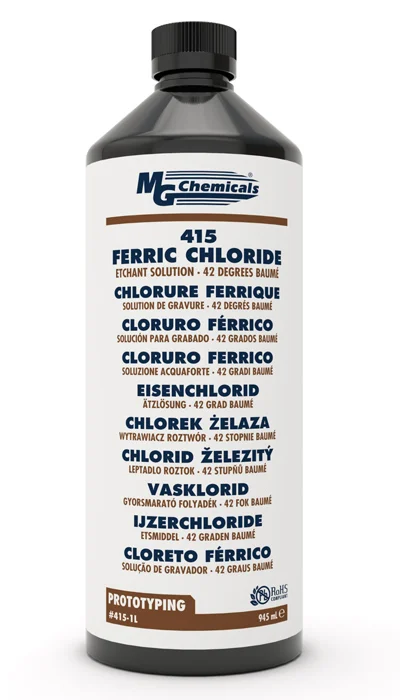
MG Chemicals 415 Ferric Chloride used during the re-etching process.
The etchant used throughout the project was MG Chemicals 415 Ferric Chloride, supplied as a ready-to-use etching solution with a concentration of 42 degrees Baumé.
Ferric chloride reacts with the iron-rich surface of the meteorite and helps reveal the contrast between the different iron-nickel structures. Muonionalusta contains structures such as kamacite and taenite, which respond differently during etching. Ferric chloride attacks the iron-rich kamacite more readily than the nickel-rich taenite, and this differential action creates the visible relief and contrast in the Widmanstätten pattern.
The process does not create the Widmanstätten pattern. The pattern already exists within the meteorite. Ferric chloride exposes it by removing microscopic amounts of material from the surface and increasing the contrast between neighbouring crystal structures.
Ferric chloride is commonly used for printed circuit board manufacture and is also widely used for Damascus steel ring etching. In Damascus steel, the etchant reveals contrast between different steel layers. In meteorite, it reveals the natural crystal structure formed during extremely slow cooling in space.
This is specialist workshop work involving ferric chloride, isopropyl alcohol and controlled neutralising. It should not be treated as a home repair process, as incorrect handling can damage the ring and create chemical waste that needs proper disposal.
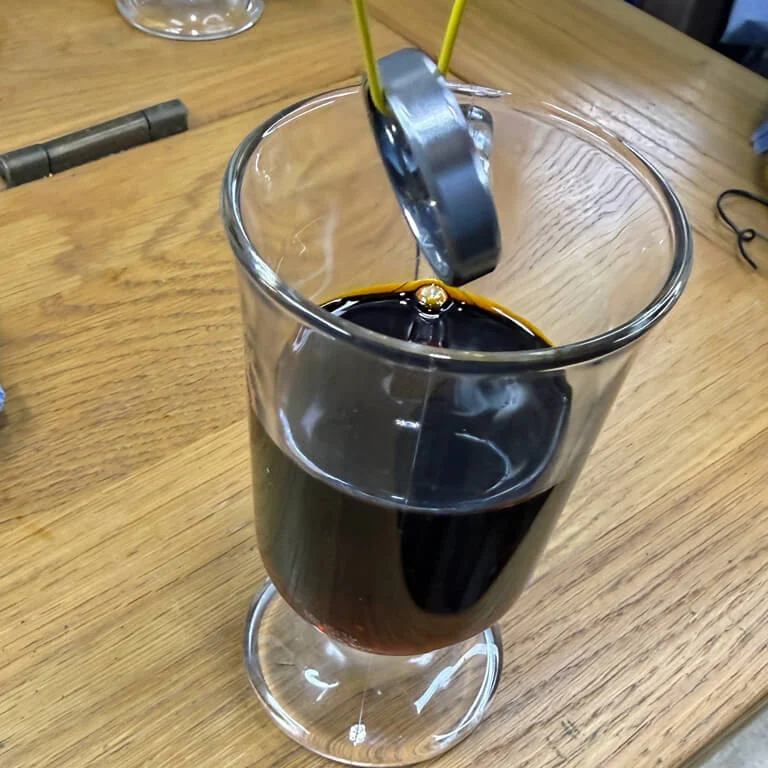
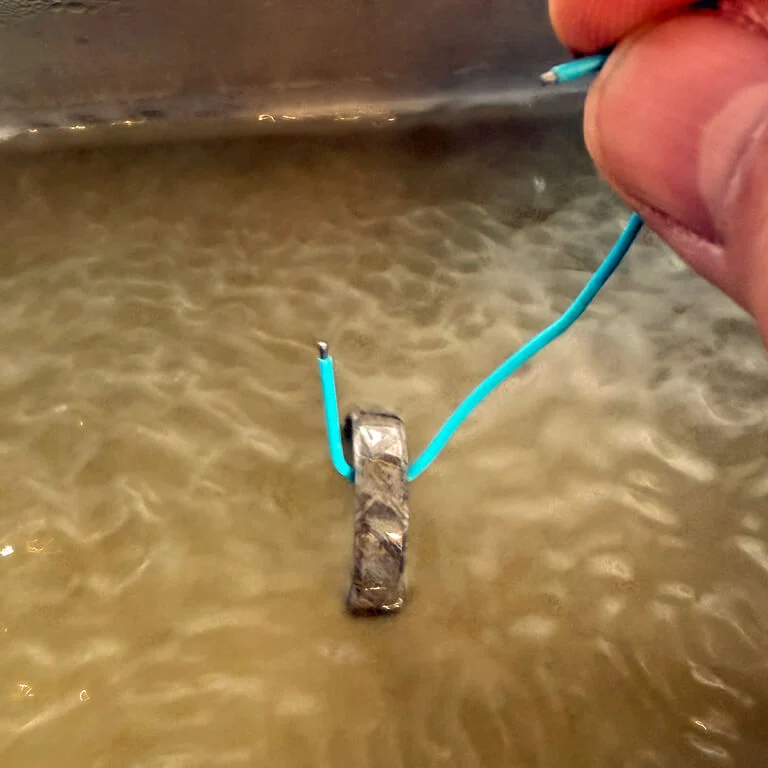
Muonionalusta meteorite ring suspended in ferric chloride during etching.
When the ring was immersed in the ferric chloride, there was very little visible bubbling. Many people expect a dramatic reaction when metal enters an etchant, particularly if they are familiar with stronger mineral acids. Ferric chloride behaves differently. It acts primarily as an oxidising etchant rather than producing the vigorous fizzing often associated with hydrochloric acid.
The lack of bubbles did not mean nothing was happening. Evidence of the reaction appeared in other ways:
The meteorite surface gradually darkened.
The Widmanstätten pattern became more visible.
Reaction products became evident during neutralisation.
The tantalum liner showed no visible reaction to the ferric chloride at any stage of the restoration.
The ring was suspended within the solution to expose the meteorite evenly around its circumference and avoid prolonged contact with the bottom of the container.
Why Meteorite and Damascus Steel Rings Are Restored in Similar Ways
Meteorite and Damascus steel are completely different materials. Meteorite is natural. Damascus steel is engineered through the forging and layering of different steels. Yet both rely on acid etching to reveal their visible pattern.
In meteorite, ferric chloride highlights the differences between iron-nickel phases such as kamacite and taenite. In Damascus steel, ferric chloride reveals contrast between different steel layers created during forging.
Although the two materials obtain their patterns in completely different ways, the restoration process shares several similarities. In both cases, wear gradually reduces surface contrast and makes the pattern less visible. Refreshing the surface, carefully controlling the etch, neutralising the reaction and protecting the finished metal all contribute to restoring the appearance of the pattern.
Damascus steel rings can be re-etched using a similar ferric chloride process because both materials rely on acid etching to reveal contrast within the surface.
This shared process is one reason why people interested in meteorite rings are often also drawn to Damascus steel rings and other alternative metal rings.
Controlled Etching Time
Following fresh surface preparation, a controlled short etch produced the best balance between pattern visibility and overall brightness. The crystal structure was easy to see, the meteorite retained a relatively light silver-grey appearance and the surface still looked suitable for regular wear.
During testing, the pattern was visible after around 30 seconds. The final result shown here was achieved after approximately 60 seconds at room temperature. Longer exposure produced a noticeably darker appearance than we wanted for this ring.
Re-etching also removes a very small amount of surface material, so it is not something that should be repeated unnecessarily. A meteorite ring can be restored, but it cannot be treated as an unlimited process.
Neutralising the Ferric Chloride
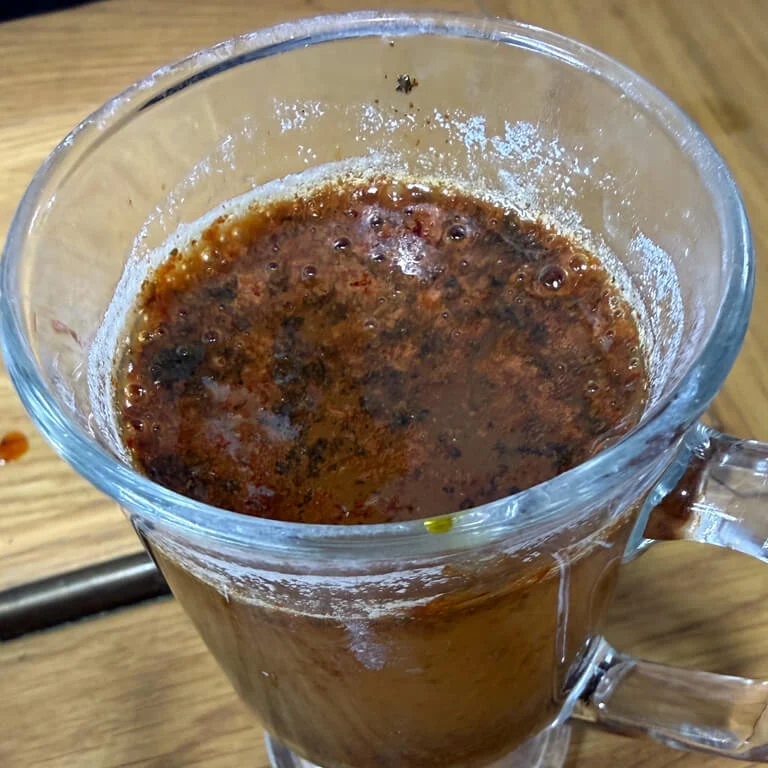
Brown reaction products suspended in the soda crystal solution.
Once removed from the ferric chloride, the ring was transferred into a solution made from soda crystals to neutralise any remaining etchant and stop the reaction.
Although the ferric chloride itself had shown very little visible reaction, the soda crystal bath quickly revealed a significant amount of brown residue. This confirmed that the etchant had reacted with the meteorite and lifted material from the surface.
When the solution was stirred, the brown residue floated through the liquid as a suspension. Some of it gathered near the surface while finer particles remained distributed throughout the bath.
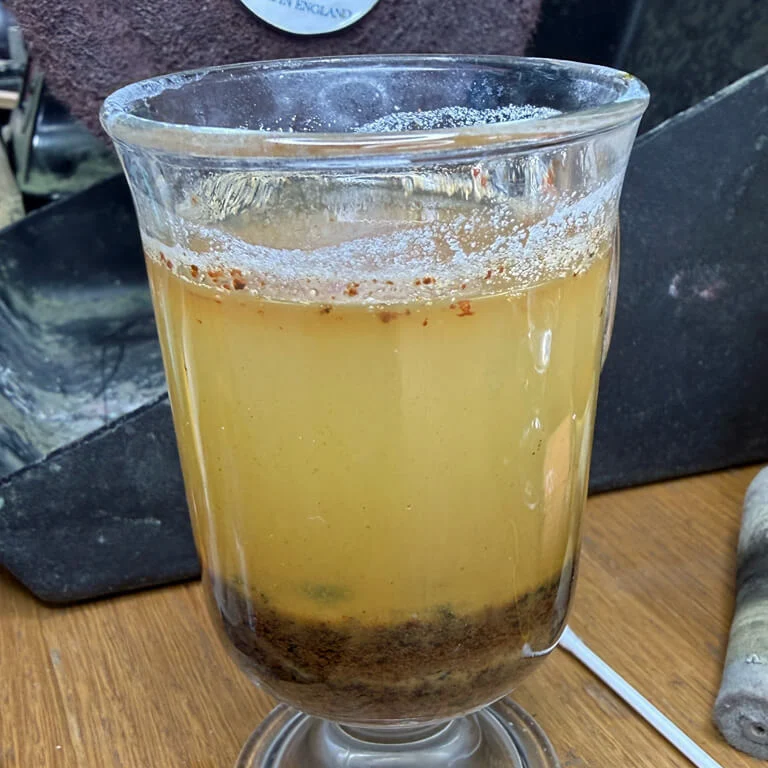
Settled residue after neutralising ferric chloride.
After the container was left undisturbed, the heavier material gradually settled to the bottom. A yellow solution remained above, while darker brown residue collected below.
During etching, ferric chloride reacts with the iron-rich surface of the meteorite and produces iron compounds, including iron hydroxides, which appear as the brown precipitate visible in the neutralisation bath. Iron hydroxide is denser than water, so the heavier particles gradually settle to the bottom once the solution is left undisturbed.
The yellow solution remaining above the settled residue is likely to be diluted ferric chloride together with dissolved iron salts still in solution. The exact chemistry was not analysed in a laboratory, so this explanation is given with appropriate professional caution rather than as a definitive chemical analysis.
The separation into two visible layers is useful. The brown settled residue below and the yellow solution above provide visible confirmation that the ferric chloride has reacted with the meteorite surface and that material has been removed during etching.
The residue shown in the photographs accumulated through the complete restoration cycle rather than from one isolated immersion. Even so, the images give a clear visual record of the material released from the meteorite surface during ferric chloride etching.
The neutralisation stage is important for three reasons. It stops the etching reaction, helps remove active ferric chloride from the surface and gives visible confirmation that the etchant has done its job.
Rinsing, Polishing and Ultrasonic Cleaning
Once neutralisation was complete, the ring was thoroughly rinsed under running water to remove remaining soda crystal solution, ferric chloride residue and reaction products from the meteorite surface.
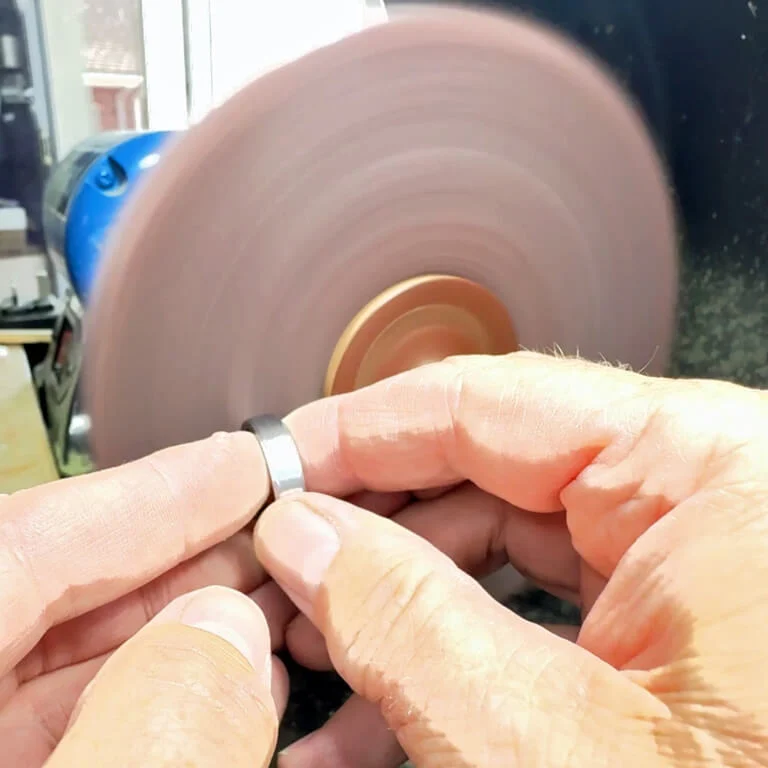
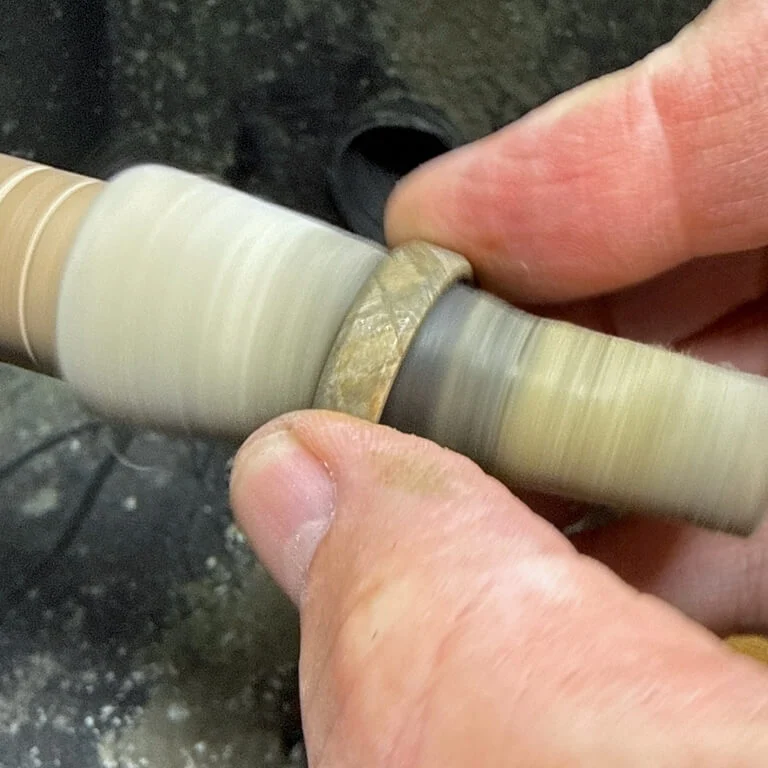
Refinishing and polishing the tantalum liner following restoration.
Although the meteorite restoration was complete at this stage, the tantalum liner was refinished before final cleaning.
The inside of the ring was carefully polished to restore its brightness. Only the tantalum liner was polished, leaving the freshly etched meteorite surface untouched.
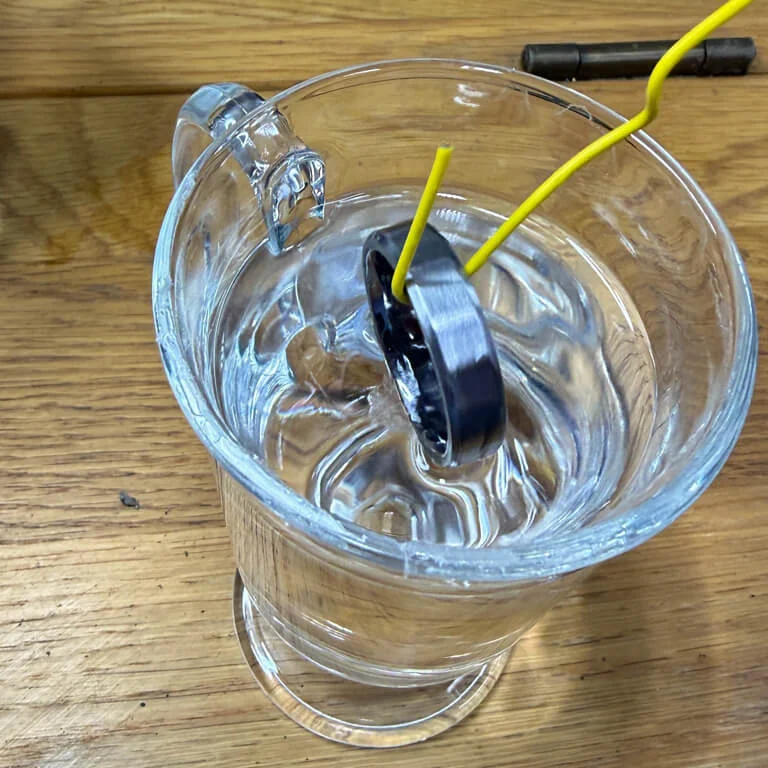
Ultrasonic cleaning removes polishing compounds and restoration residues.
Following polishing, the ring was placed into an ultrasonic cleaning tank. This removed polishing compound, cleaning residue and any remaining restoration chemicals from both the meteorite and tantalum surfaces.
After ultrasonic cleaning, the ring was rinsed thoroughly under running water before moving to the isopropyl alcohol stage.
Cleaning With Isopropyl Alcohol
Isopropyl alcohol used to displace moisture and clean the etched surface.
After the running water rinse and ultrasonic cleaning, the ring was transferred into an isopropyl alcohol bath. The alcohol helped displace residual water from the etched meteorite surface and supported the final drying process.
The ring appeared noticeably cleaner and lighter while immersed in the IPA. Much of the brown and yellow colouring visible immediately after etching was reduced, suggesting that some of the darker tone seen earlier in the process was caused by residual moisture and reaction products.
Drying the Ring
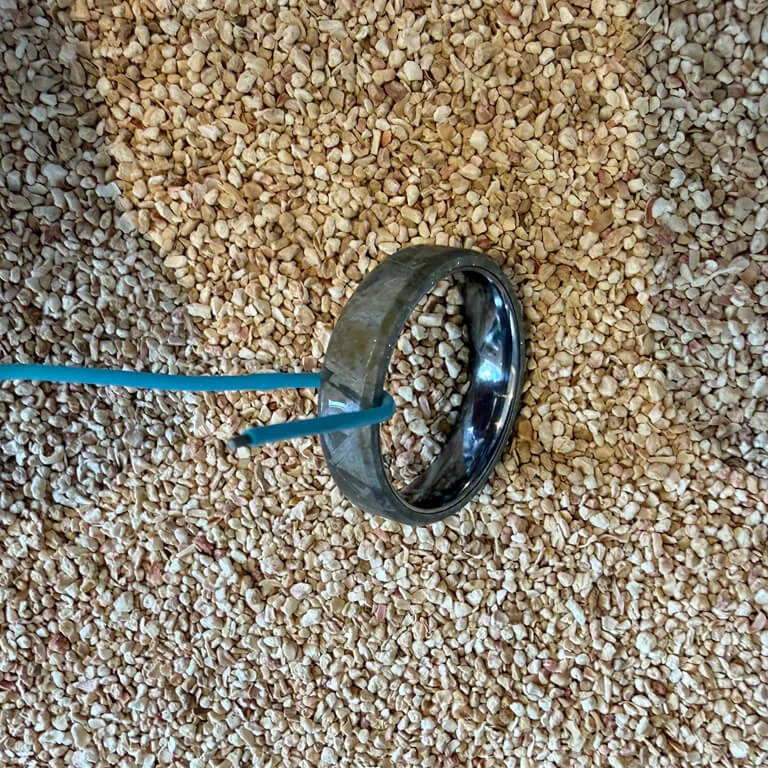
Commercial jewellery drying media used during the restoration process.
Meteorite does not tolerate trapped moisture particularly well, so drying was treated as its own stage.
Following the IPA bath, the ring was placed into commercial jewellery drying media. The drying media used throughout the project is designed specifically for jewellery applications and is intended to absorb moisture from articles placed within it.
To assist the process, the media was gently warmed by placing the dish on top of an ultrasonic cleaner. The ring remained in the warmed drying media until all visible moisture had been removed.
Final Protection With Renaissance Wax
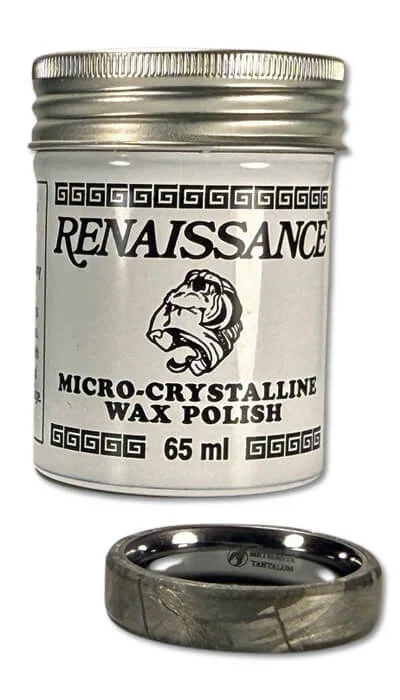
Finished meteorite ring alongside the Renaissance Wax used for final protection.
Once fully dry, the ring was finished using Renaissance Wax. Only a very light coat was applied. The intention was not to create a visible coating, but to provide a thin protective barrier while preserving the appearance produced by the etching process.
During planning, alternative protective finishes were considered, including clear resin-style coatings. Renaissance Wax was chosen because it maintained the natural appearance of the meteorite and did not mask the etched surface.
Importantly, the wax did not dramatically alter the appearance of the ring. The Widmanstätten pattern remained clearly visible and the meteorite retained its satin finish.
The Final Result
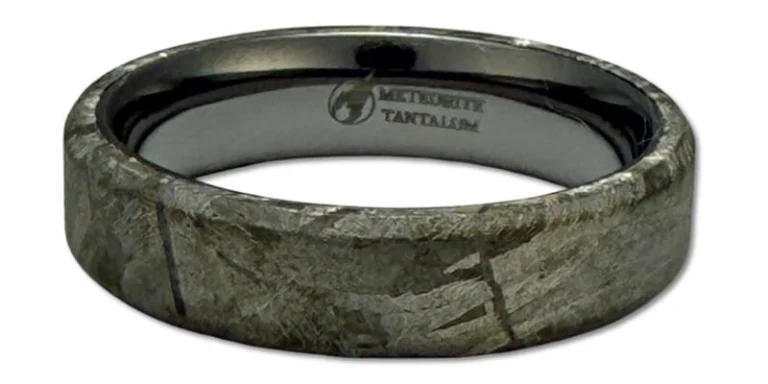
Finished Muonionalusta meteorite ring after re-etching and a light application of Renaissance Wax.
The finished ring showed a clear return of the Widmanstätten pattern across the meteorite surface. The tantalum liner had also been refinished and cleaned before the final drying and wax stage.
Once completely dry and waxed, the ring looked very different from the dull grey band that entered the workshop. The Widmanstätten pattern was once again clearly visible across the surface, and the meteorite had returned to a silver-grey appearance rather than the darker brown-grey tones seen during longer etches.
After a light application of Renaissance Wax, the finish was complete. The wax subtly enriched the appearance of the meteorite without masking the pattern. The contrast remained visible, the satin finish was retained and the tantalum liner remained unaffected throughout the process.
Comparing the finished ring against the original photographs shows how much visual contrast had been lost through wear and how effectively it could be restored through careful surface preparation and controlled acid etching of meteorite surfaces.
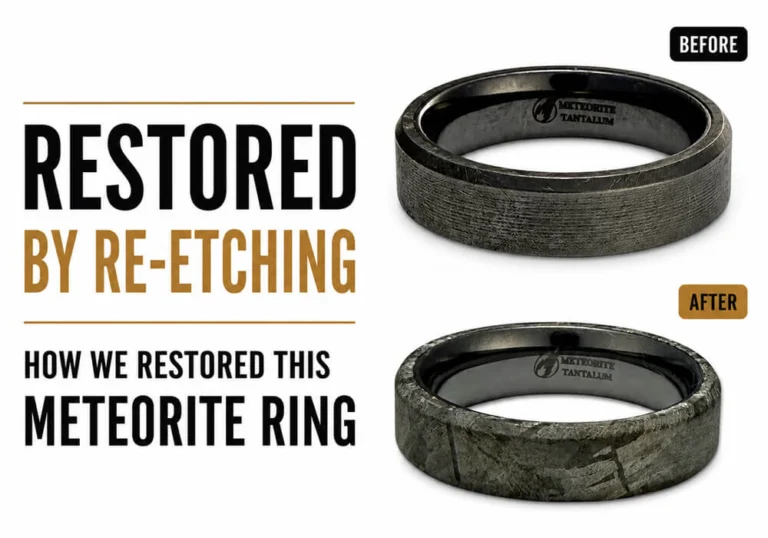
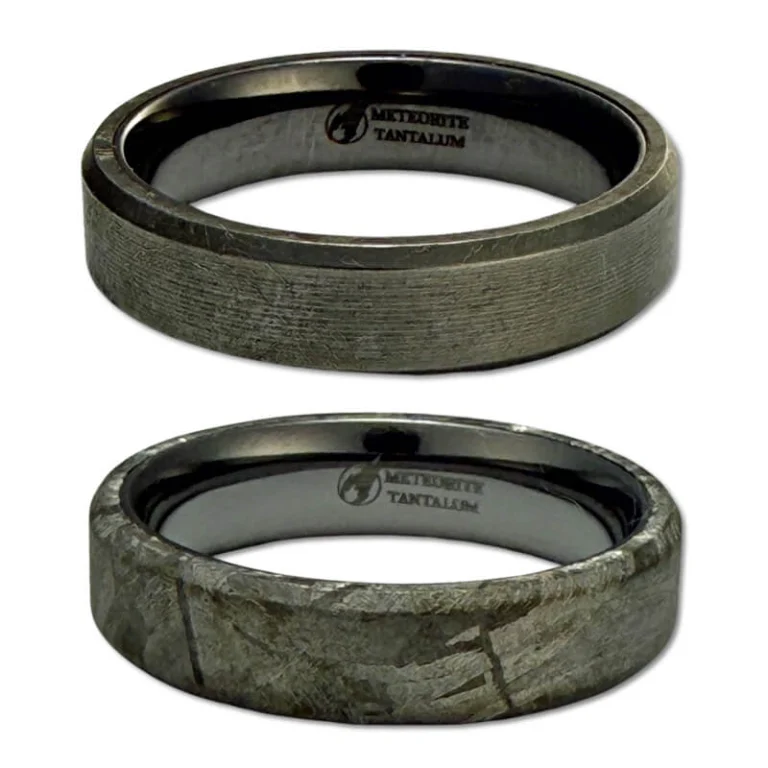
Before and after comparison of the meteorite ring re-etching project.
The before and after comparison shows the change in surface contrast. The work restored the visible meteorite pattern without changing the bonded tantalum construction.
What This Project Taught Us
The most useful finding from this job was a simple one. The longest etch did not give the best result. A short, controlled etch over a freshly prepared surface gave the best balance of pattern and brightness, while a longer immersion deepened the contrast but darkened the meteorite without improving the finish.
Surface preparation mattered as much as the etch itself. A clean, evenly prepared satin surface was what allowed the ferric chloride to work consistently, and the etchant remained effective despite producing very little visible bubbling. Throughout the work the tantalum liner showed no reaction of any kind.
The supporting stages each earned their place. Neutralisation in soda crystals stopped the reaction and produced a visible residue that confirmed the etchant had reacted with the meteorite. The ring was then rinsed, the tantalum liner was refinished, and ultrasonic cleaning removed polishing residue before the isopropyl alcohol stage. Complete drying remained important because meteorite does not tolerate trapped water well. The bonded construction remained stable throughout.
Taken together, a freshly prepared surface, a controlled etching time, proper neutralisation, careful cleaning and complete drying produced the best overall finish. Extending the etch added depth but also added darkening, and balancing the two mattered more than simply leaving the ring in the ferric chloride for longer.
This is also where the work mirrors Damascus steel closely. The two materials form their patterns in completely different ways, one through the slow cooling of an iron-nickel asteroid and the other through forged and layered steel, yet both are restored by the same disciplined sequence of surface preparation, controlled etching, neutralisation and protection. A jeweller comfortable re-etching one is well placed to restore the other.
Most importantly, the restoration confirmed that a worn meteorite ring does not necessarily need aggressive intervention to recover its appearance. Careful preparation and measured etching were enough to bring the Widmanstätten pattern back into clear view while retaining the satin character that suited the ring when it arrived in the workshop.
For readers interested in the materials discussed in this article, our collections of meteorite rings, tantalum rings and Damascus steel rings provide further examples of how these distinctive materials are used in modern jewellery. The same principles apply whether you are restoring a worn meteorite ring or simply trying to understand why it lost its contrast.
Goldsmith with 38 years’ bench experience. I started repairing jewellery for leading high-street chains, then joined an independent jeweller in 1994, specialising in turning old gold into bespoke pieces. In 2009 I became co-owner and built the firm into one of Maidstone’s most respected jewellers. After selling the business to the team in 2025, I now run Titan Jewellery’s workshop full-time. I’ve worked with alternative metals since 2002 and launched TitanJewellery.co.uk in 2012 to showcase titanium and other modern materials.
How Durable Are Alternative Metal Rings Alternative Metal Ring Durability Guide: 13 Materials Compared (2026) Durability is one of the most common concerns when choosing a…
How to Identify and Remove Rings in an Emergency On-Finger Assessment When a ring becomes stuck on a finger, two priorities come first: circulation and swelling,…
Sellerdeck to WooCommerce: Our Journey From Sellerdeck to WooCommerce: Why We Finally Moved After 23 Years I have worked with Sellerdeck websites for 24 years. When…
Common Misconceptions About Alternative Metal Rings What People Get Wrong About Alternative Metal Rings Alternative metal rings are no longer unusual. Materials such as titanium, tungsten…
35 Fascinating Facts About Tantalum . Some Facts about Tantalum Rings Tantalum is one of the least familiar metals used in modern jewellery, yet it has…
UK Based Stock
We dispatch directly from our Kent Location.
Fast Dispatch
Stock orders placed by 1pm usually sent same working day
Easy Returns
30 day no quibble refund or exchange policy
Expert Support
Speak to our Goldsmith with over 35 years jewellery experience
Manage Consent
To provide the best experiences, we use technologies like cookies to store and/or access device information. Consenting to these technologies will allow us to process data such as browsing behavior or unique IDs on this site. Not consenting or withdrawing consent, may adversely affect certain features and functions.
Functional
Always active
The technical storage or access is strictly necessary for the legitimate purpose of enabling the use of a specific service explicitly requested by the subscriber or user, or for the sole purpose of carrying out the transmission of a communication over an electronic communications network.
Preferences
The technical storage or access is necessary for the legitimate purpose of storing preferences that are not requested by the subscriber or user.
Statistics
The technical storage or access that is used exclusively for statistical purposes.The technical storage or access that is used exclusively for anonymous statistical purposes. Without a subpoena, voluntary compliance on the part of your Internet Service Provider, or additional records from a third party, information stored or retrieved for this purpose alone cannot usually be used to identify you.
Marketing
The technical storage or access is required to create user profiles to send advertising, or to track the user on a website or across several websites for similar marketing purposes.






 Winner of King award for Alternative Metal Rings
 Winner of Theo Paphitis (Dragons Den) Small Business Award
 We are fully pci-dss compliant
 Security Headers rate us A+ for website security
 We are registered with the ico for data protection
 We are members of The Guild of Jewellery Designers