
Free UK Delivery | 30 Days Return Policy

Damascus Steel Rings Buyers Guide

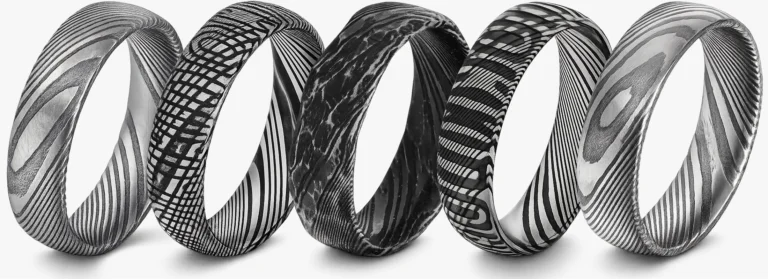
Five Damascus steel rings displayed side by side, each showing a different pattern
Quick Summary

Damascus Steel Rings Buyers Guide

They are usually the ring someone looks at twice.

The first time out of curiosity. The second time when they realise the pattern is not printed on the surface and not going to repeat on anyone else’s hand.

We notice it often in customer messages. Someone arrives expecting a standard polished band, then pauses when they see the layered pattern up close. The reaction is quieter than with gold or black zirconium. More of a lean-in than a step back. For many, especially those researching unique wedding rings for men, that pause is the moment it clicks.

What Damascus steel actually is

What most people call Damascus steel is technically pattern welded steel. Damascus is the name people recognise. Pattern welded steel is the accurate term.

Our Damascus steel rings are made from 72 alternating layers of 304L and 316L stainless steel, forge welded into a single billet. There is no carbon steel involved. We use 304L and 316L because they comply with UK and EU nickel regulations and are suitable for prolonged skin contact.

In practical terms, each stainless steel Damascus ring is a solid piece of layered stainless steel, not a surface treatment applied to another metal.

The pattern is created by manipulating that layered billet before machining. After shaping, the surface is etched to reveal the structure within. The pattern runs through the depth of the ring. It is not surface decoration and it is not a coating effect.

Each ring also carries a “Damascus Steel” marking inside the band as an authenticity detail, confirming the material.

When someone asks whether it is “real Damascus”, what they usually mean is whether the pattern is structural. It is.

What Makes These Rings Different

Every Damascus steel ring is structurally distinctive.

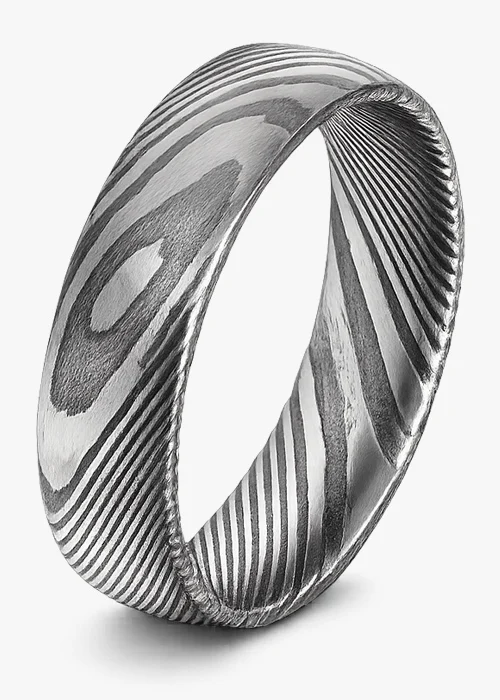
When we cut a ring blank from a billet, the visible pattern depends on where that cut falls. A size R comes from a different section of the billet than a size Z. Even two rings of the same design and size will show different sections of the underlying layered pattern.

That is not a marketing feature added at the end. It is simply how layered steel behaves when you machine through it.

For customers exploring alternative wedding rings, the appeal is often this individuality. It does not look like a standard polished band. It has depth and variation that you cannot replicate with a single-alloy metal.

There is also a tactile quality that photographs do not fully show. The etched layers create a subtle three-dimensional surface. You can feel the structure. The edges of the layers are physically present, giving the ring a slightly industrial texture. For many people that is exactly the attraction. If you are looking for perfectly smooth, mirror-flat metal, Damascus steel may not be the right choice, and one of our other metals would likely suit you better.

The weight tends to surprise people as well. Damascus steel is heavier than titanium but lighter than tungsten carbide for the same dimensions. Someone used to titanium often comments on the extra presence. Not heavy, just more substantial.
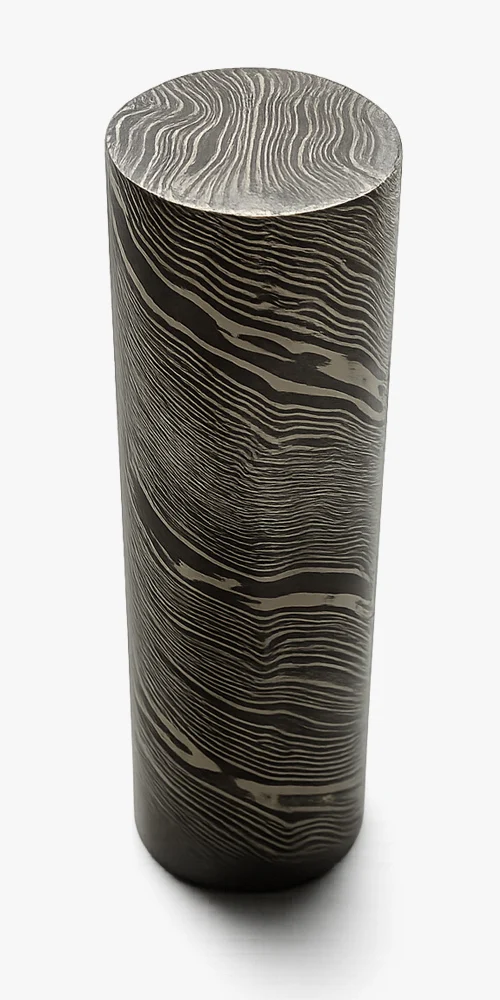
Damascus Steel Rod

The four designs

All of our Damascus steel rings use a court profile with a curved exterior and comfort-fit interior.

These Damascus steel rings are held in stock for fast dispatch.

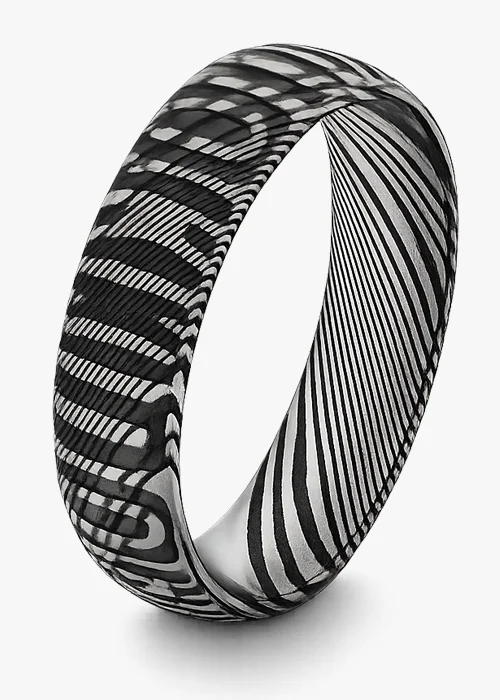
Woodgrain

If someone is unsure where to start, Woodgrain is usually the design we recommend first.

This is the pure stainless version with no coating. The contrast comes entirely from etching the 304L and 316L layers. In the workshop, it is the design that most clearly shows what pattern welded steel actually looks like in cross-section.

Woodgrain gives the clearest engraving results within the Damascus range because the laser works directly with stainless steel rather than cutting through a surface finish. Even so, engraving on Damascus steel is less consistent than on single-alloy metals such as titanium or tantalum.

Woodgrain is 6mm wide and available in UK sizes M to Z+3.

Tribal

Tribal is often the design people notice first when comparing options side by side online.

It uses the same 72-layer stainless construction but with a black PVD finish over the etched surface. The pattern is more angular and pronounced.

PVD is a hard-wearing industrial coating, the same process used on premium watch cases and tools. It is significantly more durable than plating or paint. With long-term daily wear, raised areas will show signs of use first, developing character rather than flaking or peeling.

Tribal is 6mm wide and available in UK sizes M to Z+3.

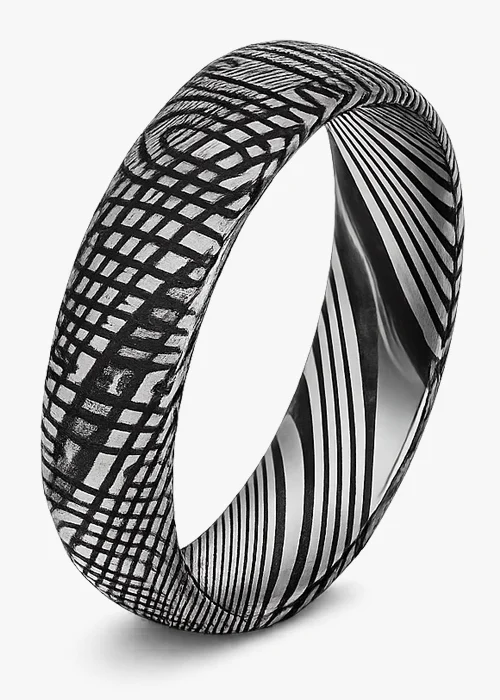
Circles

Circles feels calmer than the other coated designs.

We often see this chosen by someone who wants a black Damascus ring but finds Tribal slightly too bold. The pattern flows rather than cuts. In hand, it feels smoother because the surface transitions are softer, and the overall effect is more understated.

Like Tribal, it uses a black PVD finish over the etched stainless layers, but the visual result reads as quieter and more fluid.

Circles is 6mm wide and available in UK sizes M to Z+3.

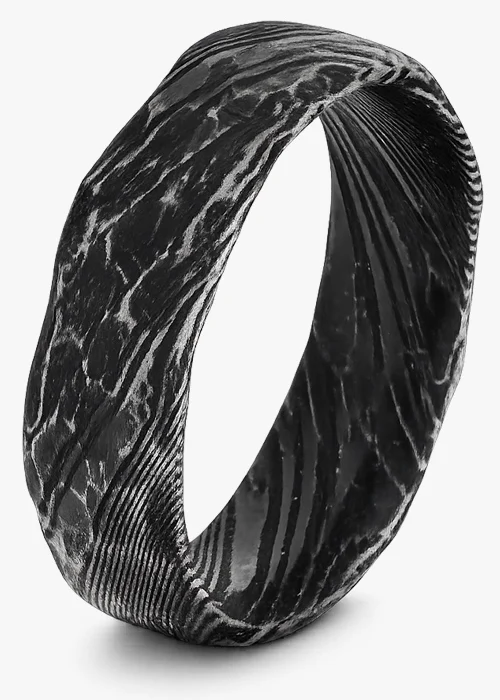
Reticulated

Reticulated is wider, deeper, and deliberately textured.

When customers send photos after receiving it, the comments are usually about the surface geometry before the pattern itself. There is more to catch the light. It has presence. It does not pretend to be discreet.

Reticulated is 8mm wide and available in UK sizes P to Z+3.

Across all four designs, the underlying material is the same layered stainless structure. Whether you describe it as a Damascus steel band or a patterned steel ring, the character comes from the same 72-layer forge welded construction.

How they wear

In daily use, these behave like stainless steel, because that is what they are.

They do not tarnish like silver. They are corrosion resistant and stable against the skin. That part is straightforward.

What changes over time is the surface. Fine marks develop. Edges soften slightly. On Woodgrain, the etched contrast can mellow with years of wear, though the pattern remains because it runs through the material.

On the black designs, the PVD coating is robust and hard wearing. It is not a paint layer. Over extended use, the highest points will show subtle signs of wear first. It tends to evolve rather than fail.

Some people like that. Others prefer to keep the finish as close to new as possible. Both approaches are valid.

What you need to know before buying

Sizing

Damascus steel rings cannot be resized.

They are made from 72 forge-welded layers of stainless steel. Resizing involves stretching or compressing the ring, which introduces shear forces across those bonded layers. That process risks delamination.

We have never experienced delamination with any of our rings. The risk during resizing is theoretical and relates to the engineering of the layered structure under that type of stress. It is not a risk we are prepared to take with a customer’s ring.

We know it is inconvenient. It would be easier if we could adjust them later. The layered construction is what makes the pattern possible, and it is also what makes resizing unsuitable.

If you are unsure of your size, take the time to measure properly before ordering. If helpful, see our ring sizing guide.

Engraving

Engraving is possible, but it behaves differently from single-alloy metals.

On Woodgrain, the laser interacts directly with stainless steel layers, so results are generally clearer within the Damascus range. Even so, engraving on Damascus steel is less consistent than on homogeneous metals.

On the black PVD designs, engraving cuts through the coating and into the layered steel beneath. The mark is more subtle because the base and surface tones are closer in colour. If strong contrast engraving is a priority, Woodgrain is usually the safer choice.

Pros and Cons of Damascus Steel Rings

Pros

Each ring displays a different section of the underlying layered Damascus pattern.

Made from 304L and 316L stainless steel, compliant with UK and EU nickel regulations.

Hypoallergenic and suitable for prolonged skin contact.

Heavier than titanium but lighter than tungsten, offering a balanced feel.

Pattern runs through the depth of the material rather than sitting on the surface.

Chosen by people who want a Damascus steel wedding ring that does not look like a standard polished band.

Cons

Cannot be resized due to the 72-layer forge-welded construction.

Engraving is less consistent than on homogeneous metals, particularly on black PVD designs.

PVD finishes, while hard wearing, will show gradual signs of extended use on raised areas.

The etched surface has a tactile, industrial texture. These rings are not smooth to the touch and may not suit those who prefer a polished, flat finish.

Surface marks will develop over time, as with any metal worn daily.

Compared to other materials

The comparison we are asked about most often is Damascus steel vs titanium.

Titanium is lighter and visually uniform. Damascus steel is denser and layered. Someone choosing titanium usually wants minimal and understated. Someone choosing Damascus tends to want individuality and texture.

Against tungsten carbide, the difference is more about brittleness. Tungsten is extremely hard and very uniform in appearance. Damascus steel is less brittle and visually complex.

In practice, Damascus steel suits someone who values the layered look and understands the resizing limitation. It is not the safest option. It is the deliberate one.

All Damascus steel rings are covered by our two-year guarantee.

If you would like to see the full manufacturing detail behind the material and process, you can read our full technical guide to Damascus steel rings.

To explore the available designs and choose your own Damascus steel band, visit .our Damascus steel rings collection

UK Based Stock

We dispatch directly from our Kent Location.

Fast Dispatch

Stock orders placed by 1pm usually sent same working day

Easy Returns

30 day no quibble refund or exchange policy

Expert Support

Speak to our Goldsmith with over 35 years jewellery experience