What to expect from daily wear
Cobalt rings are designed for everyday use. The alloy resists surface wear better than most traditional jewellery metals.
Customers sometimes ask do cobalt rings scratch. The honest answer is that all metals will eventually develop marks during daily wear. The difference with cobalt is that scratches tend to develop more slowly and usually appear finer than on softer metals.
The alloy’s toughness is what distinguishes it most clearly from brittle materials. Cobalt chrome absorbs energy under impact rather than fracturing. This behaviour is one of the reasons the alloy is used in demanding engineering applications.
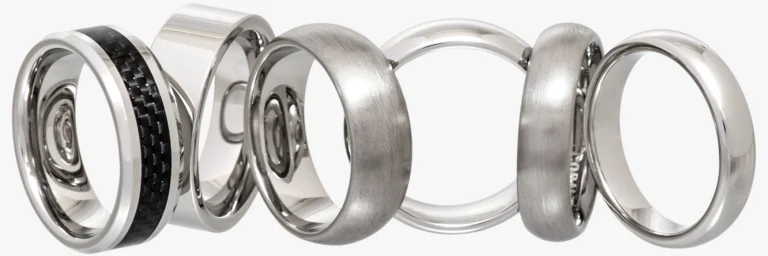
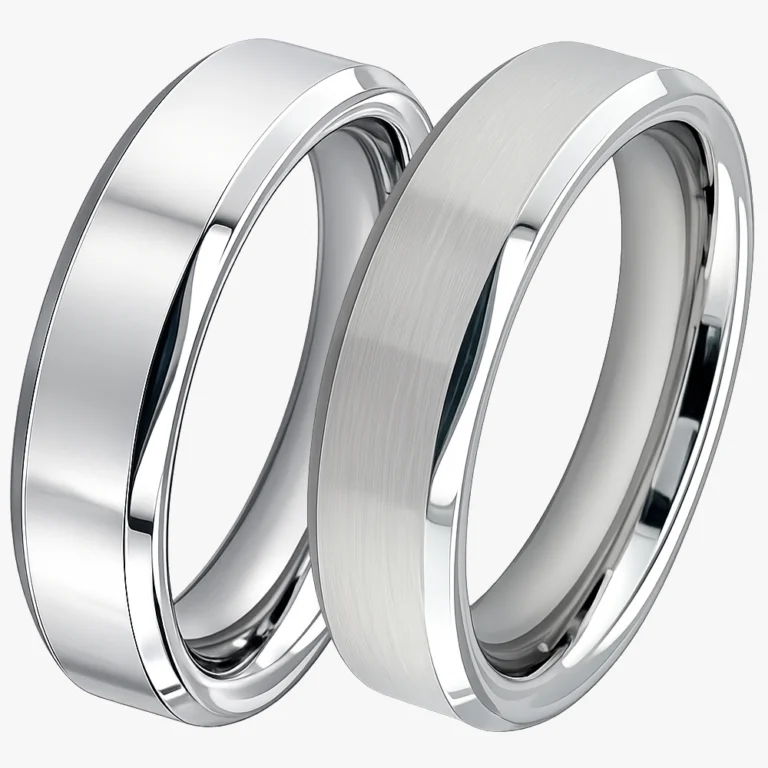
Finish choice also affects how wear appears. Polished finishes reflect light strongly and will eventually show surface marks more clearly. Brushed finishes scatter light and tend to hide small marks more effectively.
Brushed finishes can also be refreshed over time by rebrushing the surface. Polished rings can be converted to a brushed finish in the future if a different look is preferred.
Finish changes are one-way. A polished ring can be converted to brushed, but brushed rings cannot be returned to polished because of the hardness of the metal.
Emergency removal
Like many alternative metals, cobalt is harder than traditional jewellery alloys. This affects how the ring is removed in a medical emergency.
Customers sometimes ask can cobalt rings be cut off if a ring must be removed quickly. They can, but the process differs from softer metals.
Standard steel ring cutters used in many hospitals are not effective on cobalt. Removal requires diamond-impregnated cutting blades.
The typical method involves making two cuts on opposite sides of the ring. Once the cuts are complete, the ring can be split and removed safely.
This type of cutting equipment is available in medical settings but is not as common as standard ring cutters used for softer metals.
More detail on the process can be found in the emergency ring removal guide, which explains the method step by step.
How cobalt rings compare with other materials
Customers often compare cobalt rings with other common wedding ring materials.
In the comparison of cobalt vs tungsten, cobalt offers similar resistance to scratching but behaves very differently under impact. Tungsten carbide is extremely hard but brittle and can fracture if struck sharply. Cobalt is tougher and dents rather than shattering. Tungsten is also heavier. More information about that material can be found on the tungsten rings page.
Looking at cobalt vs titanium, cobalt is harder and more resistant to scratching. Titanium is lighter on the finger and more flexible. Cobalt has a brighter white appearance, while titanium appears greyer in tone.
White gold is another common comparison. Cobalt maintains its white colour naturally, whereas white gold relies on rhodium plating to maintain its bright appearance. That plating eventually wears and must be replaced. The process is explained in the rhodium plating guide. White gold can also be resized, which cobalt cannot.
Some customers researching cobalt wedding rings are also considering black rings. Cobalt is a naturally white metal, so customers looking for black finishes are usually better suited to ceramic or zirconium rings instead.
Important things to know before ordering
A common question is can cobalt rings be resized. They cannot be resized after manufacture, so accurate sizing before ordering is important.
Our cobalt rings are available in UK sizes from J to Z+10 depending on the design. Narrow widths such as 3mm and 4mm begin at size J, which covers smaller finger sizes and makes cobalt rings for women possible across the range. Wider rings typically begin around size N and extend upward into larger sizes.
If the size ordered is incorrect, we offer a free exchange so that the correct size can be supplied.
The range currently includes around thirty designs covering widths from 3mm to 8mm. Both court and flat profiles are available, along with chamfered edges, ridged surfaces, and faceted designs.
Comfort fit interiors are used on wider rings to improve how the ring passes over the knuckle and sits on the finger.
Most designs are available in either polished or brushed finishes. One design in the range also incorporates a black carbon fibre inlay for a two-tone appearance while retaining the white cobalt base metal.
Both men’s and women’s sizes are available across the range, making cobalt wedding rings suitable for a wide range of finger sizes and style preferences.
In terms of weight, cobalt sits between titanium and heavier materials such as tungsten or tantalum. It feels solid and substantial without being excessively heavy, and its density is broadly similar to steel.
The alloy is also hypoallergenic and biocompatible. Cobalt chrome is used in medical implants because it performs well inside the human body. Nickel content is typically below 0.5 percent and tightly bound within the alloy structure. The material does not tarnish and will not discolour skin. Anyone with a severe nickel allergy should consult a medical professional before choosing any metal ring.
Cobalt rings pros and cons
Pros
Extremely tough metal that will not shatter, crack, or fracture under impact.
Very strong resistance to scratching. Surface wear develops slowly compared with softer metals.
Naturally bright white colour similar to white gold, achieved without plating.
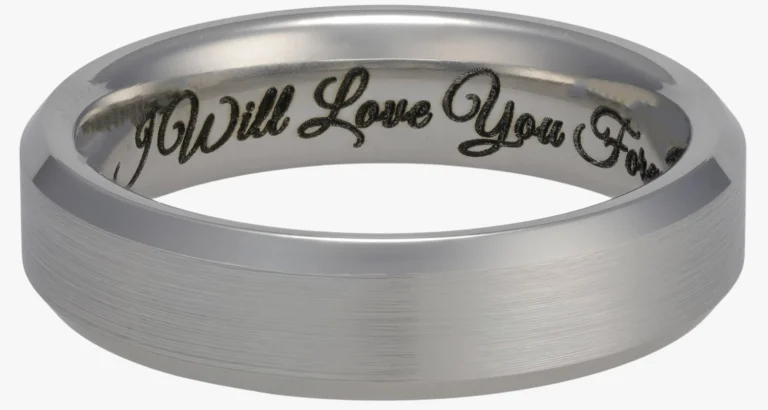
Engraves cleanly, and black engraving produces strong contrast against the metal.
Hypoallergenic and biocompatible, with medical use in implant technology.
Available across a wide size range for both men and women.
Brushed finishes can be refreshed over time if the surface becomes worn.
Cons
Cobalt rings cannot be resized after manufacture.
Emergency removal requires diamond cutting blades rather than standard hospital ring cutters.
Once a polished finish shows wear it cannot be restored to its original mirror polish. The practical change is conversion to brushed.
Heavier than titanium, though still lighter than tungsten.
Is a cobalt ring right for you
Cobalt wedding rings suit customers who want a bright white metal ring with strong durability and minimal maintenance.
The alloy performs well for active lifestyles and environments where rings are exposed to regular knocks or abrasion. Its toughness and resistance to surface wear make it one of the most practical materials for everyday wedding rings.
At the same time, the limitations are straightforward to understand. The ring cannot be resized, and emergency removal requires specialised cutting equipment.
For many customers the balance works well. Cobalt wedding rings offer the appearance of a bright white metal combined with durability drawn from an alloy originally designed for demanding engineering and medical applications.