Why choose tungsten carbide wedding rings
Working with tungsten rings every day quickly shows how differently this material behaves compared with traditional jewellery metals. Engraving, finishing, and occasionally replacing rings that have been worn for years provides a clear picture of how tungsten carbide performs outside technical descriptions.
Tungsten carbide wedding rings are not made from a pure metal. They are a composite material formed by combining tungsten particles with a small percentage of metallic binder and consolidating the mixture into a dense solid through high-temperature sintering.
Hardness defines the material. The composite resists surface wear to a degree that most metals cannot approach. Once manufactured it also remains dimensionally stable, which is why the shape and edges of the ring change very little over time.
At the same time it behaves more like an engineering ceramic than a ductile metal. It does not bend, cannot be resized, and reacts differently under impact.
Understanding those characteristics makes choosing tungsten carbide wedding rings much easier.
Quick summary
Tungsten carbide wedding rings are extremely hard and highly scratch resistant. Polished finishes keep their appearance for far longer than most jewellery metals.
That hardness also explains the main limitation. Tungsten rings do not bend or stretch, so resizing is impossible and sharp impacts can occasionally cause chipping.
Most people researching tungsten rings pros and cons are simply deciding which of those characteristics matters more for their lifestyle.
Readers who want the full metallurgy behind the material can explore it in the tungsten carbide technical guide.
What makes tungsten carbide different
Most jewellery metals share a common trait. They are ductile.
Gold, platinum, and titanium can flex slightly under pressure, which is why jewellers can resize or reshape them when necessary.
Tungsten behaves very differently.
The composite structure is formed from tungsten particles bonded together with a metallic binder. That structure creates a very dense and extremely rigid material.
Hardness is the first property most people notice. On the Mohs scale it sits between roughly 8.5 and 9. Gold alloys normally fall around 2.5 to 3, while titanium sits close to 6. Even harder jewellery alloys such as cobalt chrome rarely exceed 6.
This gap explains tungsten ring scratch resistance. Materials that would quickly mark precious metals often leave tungsten rings largely unchanged.
Weight is another immediately noticeable characteristic. With density between roughly 14.5 and 15.5 grams per cubic centimetre, tungsten carbide feels similar in weight to a gold ring while being far heavier than titanium.
Pick one up and the difference is obvious. Customers who expect an alternative metal ring to feel light often pause for a moment when they first handle tungsten rings because the weight feels familiar, closer to traditional precious metal rings.
Jewellery-grade tungsten carbide uses nickel binder systems rather than cobalt binders. The nickel remains locked within the carbide matrix and complies with EU nickel release regulations.
In practice the material is suitable for prolonged skin contact while retaining its mechanical properties.
How tungsten carbide rings are made
Tungsten carbide rings are not cast or forged like precious metal rings.
Manufacture relies on powder metallurgy.
Tungsten powder is blended with binder powder and compacted under pressure into a ring-shaped blank. The compact then enters a furnace where temperatures reach roughly 1400 to 1600°C.
During sintering the binder phase melts and flows between the tungsten particles, bonding them together into a dense solid structure.
Once this stage finishes it is already fully hardened.
Machining tungsten carbide requires diamond abrasives, so rings are manufactured to their final dimensions during production rather than altered afterwards.
That manufacturing process explains why resizing is impossible.
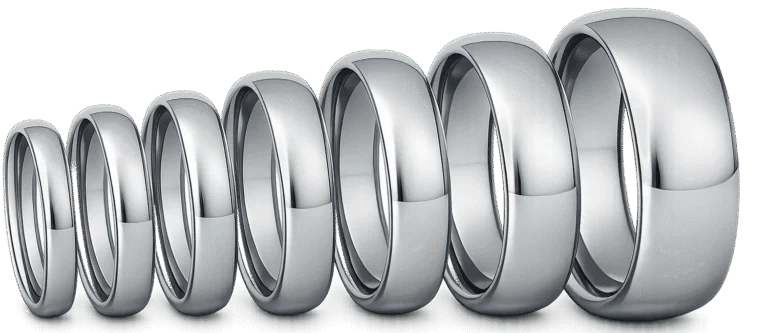
Sizing accuracy therefore matters. Wider rings cover more surface area on the finger and often feel tighter than narrow rings of the same size.
Most tungsten rings are produced with a comfort-fit interior, meaning the inside edge is slightly curved rather than flat. This helps wider bands slide over the knuckle more easily and improves comfort once worn.
Even with a comfort-fit interior, width still influences sizing. Someone measured at size M using a narrow gauge may prefer half a size larger when ordering an 8mm band.
Getting this right before ordering makes a real difference.
Tungsten ring scratch resistance in daily wear
Durability at the surface is the reason many people choose tungsten rings.
Polished tungsten carbide wedding rings keep their reflectivity for long periods. Precious metals gradually develop fine scratches that soften the surface. The material resists this process because it is extremely hard.
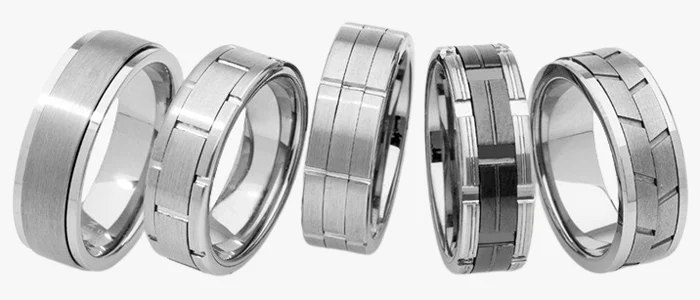
Brushed finishes behave in a similar way. The satin grain created during finishing tends to remain visible even after extended use.
Experience with returned rings highlights the difference clearly. Rings worn daily for several years often show remarkably little change to the finish.
That durability is exactly why mens tungsten rings UK customers rely on the finish holding up through daily wear.
The material is not scratch-proof.
Materials with comparable hardness such as ceramics, hardened steels, or other carbide surfaces can still mark the ring if contact occurs under pressure.
For everyday activities such as office work, driving, or typical household tasks, visible wear is usually minimal. That is why tungsten ring durability is one of the material’s main advantages.