Free UK Delivery | 30 Days Return Policy

Titanium Wedding Rings Buyers Guide

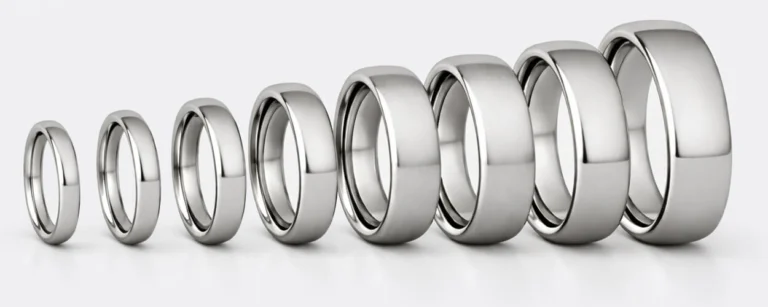
Grade 2 Titanium Wedding Rings Pros and Cons with 8 titanium rings
Quick Summary

Choosing a wedding ring is easier when you know what the metal is actually like to live with. Titanium has been one of our core ring metals since 2002, and after handling it for that long the same questions come up again and again. People want to know how light it feels, how it wears, whether it can be engraved, and where the trade-offs sit. That is what matters here.

What to expect from a titanium wedding ring

The first thing most people notice is the weight, or rather the lack of it. Pick up a titanium ring for the first time and it often feels lighter than expected, especially if you have only handled gold or platinum wedding bands before. A 6mm titanium ring weighs roughly the same as a 2mm gold band, so even a wider ring can feel unexpectedly light on the hand.

Colour is the next thing people tend to look at closely. Grade 2 commercially pure titanium (99% pure) has a grey tone rather than the bright white of white gold or the warmer white of sterling silver. Out of the precious metals, it sits closest to platinum in appearance, though it is noticeably darker and less reflective.

Once on the finger, titanium tends to feel easy to forget. Because it is so light, people who dislike heavy rings often settle into it quickly. For someone moving from a traditional precious metal, that difference can be the deciding factor. It does not feel flimsy, just noticeably lighter for its width.

Titanium ring durability

Titanium ring durability is one of the main reasons people look at it in the first place, but it helps to be realistic about what that actually means day to day. Grade 2 titanium sits at about 6 on the Mohs hardness scale. In everyday terms, that means it resists bending and distortion well, even with regular knocks from doors, desks or general hand use, but it will still pick up surface marks over time.

In day to day terms, the real strength of titanium is not that it stays cosmetically perfect. It is that it holds its shape extremely well. Titanium first proved itself in aerospace and motorsport engineering, where a high strength-to-weight ratio is critical, before it reached jewellery. We have been selling titanium rings since 2002, and in that time not one has been returned bent, buckled or broken. The ring itself does not weaken or lose its shape over time. Surface marks will appear with wear, but the ring underneath stays exactly as it was.

It also deals well with ordinary exposure. Titanium does not tarnish, corrode or discolour over time. Sweat, seawater, household chemicals and normal domestic chlorine levels do not cause the sort of surface reaction people may have seen with other metals. For anyone who wants a ring they can wear daily without worrying about tarnish or corrosion, that is a genuine advantage.

Hypoallergenic and biocompatible

Grade 2 titanium is nickel-free and biocompatible, meaning the body does not react to it. It is the same grade used in surgical implants such as hip replacements, dental implants and pacemaker cases. For anyone who has experienced skin irritation from other jewellery metals, titanium is a great alternative.

Titanium compared to gold and platinum

Titanium sits at a much lower price point than gold or platinum, which is a practical factor for many buyers. Because titanium rings are not easily resized, that lower cost also makes replacement a more realistic option if finger size changes over time.

The weight difference is usually the first thing people notice, as described earlier, and that contrast remains one of titanium’s defining characteristics. Colour is also different. Titanium has a grey tone, while gold ranges from yellow to white depending on alloy, and platinum has a brighter white appearance.

In terms of hardness, titanium at around 6 on the Mohs scale is harder than gold and platinum, so it resists bending more effectively in daily wear. It is not the hardest option available, but it sits in a middle ground where it offers good shape retention without behaving like very hard materials such as tungsten.

Scratching and everyday wear

Titanium marks in wear, often quite quickly, and that is normal. Every ring worn every day will pick up signs of contact, whether that is from keys in a pocket, a door handle, a desk edge or general hand use. Our guide to why rings scratch explains this behaviour in more detail across different metals.

On a polished titanium ring, the first signs of wear usually show as fine surface marks that catch the light differently as the hand moves. On a brushed ring, contact points gradually show polished marks through the brushed finish. That tends to happen on the areas that take the most daily contact, so the finish starts to change according to how the ring is actually worn.

Over time, polished and brushed titanium both settle into a worn-in patina. They do not stay pristine, but neither does gold or platinum. Daily wear gives the surface a used look that most people simply come to see as part of the ring.

If surface wear is likely to bother you, it may be worth looking at cobalt chrome rings. Cobalt has a brighter white colour and generally offers better surface durability, although it will still mark over time because everything does.

We can repolish or rebrush titanium in the workshop, so refinishing is possible. That said, it is not always cost-effective. Depending on the ring and the labour involved, the work can approach the value of the ring itself, so it is better viewed as an available option rather than something every titanium ring will routinely need.


Engraving titanium rings

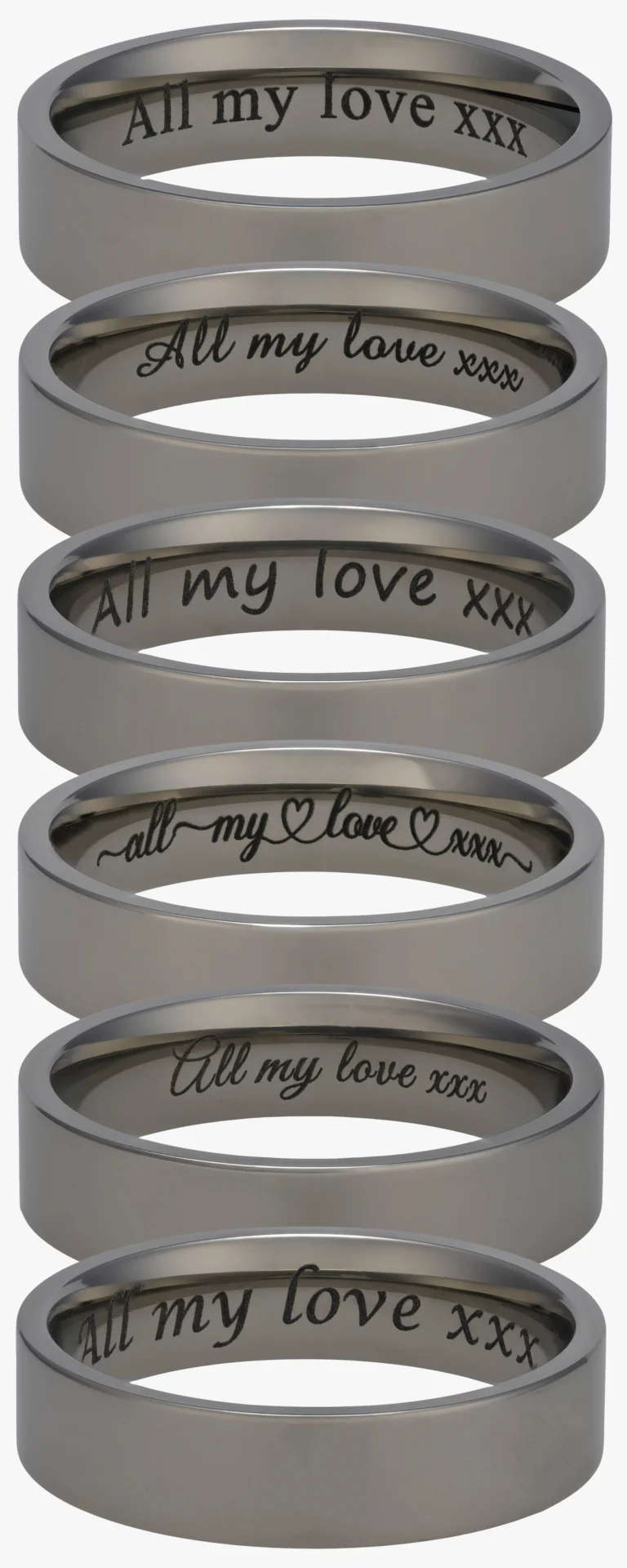
Titanium is one of the best alternative metals for engraving. Laser engraving produces a crisp black contrast that stands out clearly against the grey surface, which is why it works so well for dates, initials and short personal messages inside a wedding ring. On a polished finish, that contrast is usually at its strongest, as the dark engraving stands out more against a brighter reflective surface.

Most titanium rings can be engraved. We carry out all engraving in our own workshop using our hi-tech laser engraver. Engraving options depend on the ring width and font choice, though finger size can occasionally be a factor if longer text is combined with a narrower ring and a chunkier font.

A selection of engraved fonts

Width affects font choice more than character count. A 3mm ring is the narrowest width we can engrave, so the font options are naturally more limited there. By 8mm, nearly all engraving fonts are available. The amount of text that fits depends more on the finger size than the ring width. For a closer look at font options, see ring engraving fonts. For a broader comparison of suitable metals and styles, see best rings for engraving.

Every titanium ring also carries our own Titanium logo discreetly laser engraved on the inside. This is a shallow engraving in a greyish white tone, more subtle than the darker contrast used for personalised engraving, and serves simply as a mark of the metal used in manufacture.

Alongside titanium, the other standout engraving metal is tantalum. If engraving is one of the main reasons you are choosing a ring, both are worth serious consideration. General engraving details are covered in our engraving guide.

A selection of engraved fonts

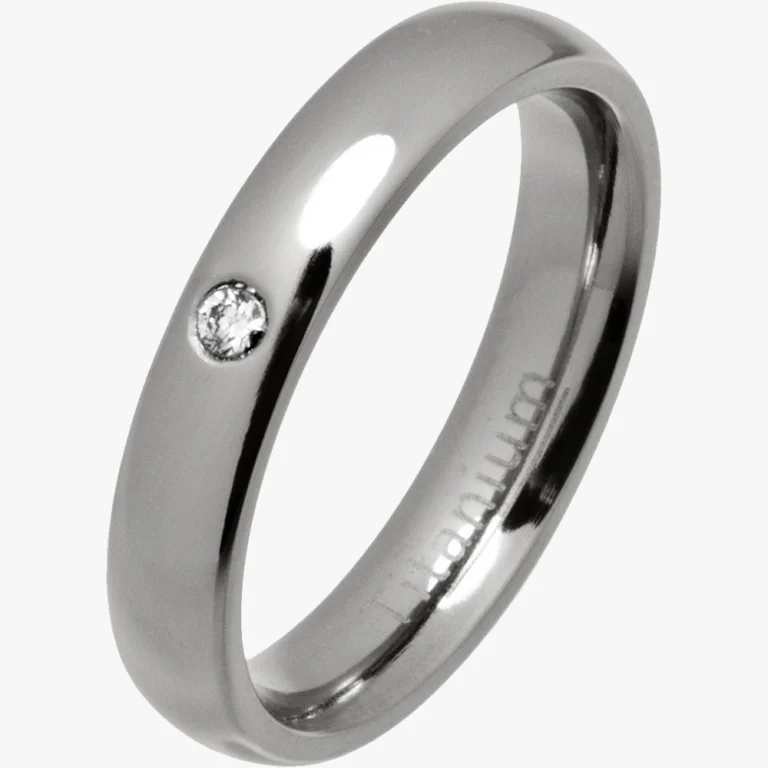
Diamond set titanium wedding ring

Diamond set titanium wedding ring

Diamond setting

Some plain titanium wedding ring designs can be set with stones on request. This is a bespoke service rather than a standard listing feature, carried out in our own workshop by a Hatton Garden trained diamond setter using an invisible pressure-setting technique with calibrated stones.

Only diamond, sapphire and ruby are suitable for this type of setting. Softer stones are more likely to crack under the compressive force involved, so the choice of stone is a practical one rather than purely aesthetic. For titanium rings, the diamonds we use are colour H, clarity SI as standard, with colour G, clarity VS available as an upgrade.

Diamond setting adds approximately two weeks to the lead time and, as a permanent customisation, makes the ring non-returnable. You are welcome to order the ring unset first to confirm that the size, design and fit are right before committing to the stone work.

Sizing and fit

Titanium rings are difficult or impossible to resize, which makes getting the size right at the start more important than it is with some precious metal rings. That is not unusual for this type of ring, but it does mean size should be treated as a permanent choice rather than something easily adjusted later.

Our stock sizes run from H to Z+6 in UK finger sizes. That covers a broad range, but the fit still needs to be considered in relation to width. A wider ring wears tighter than a narrow one in the same finger size. Someone comfortable in a narrow band may find a much wider ring feels snugger simply because more surface is sitting against the finger. Our ring width guide helps explain this further.

Emergency removal

Titanium rings can be removed in an emergency using a standard ring cutter, the same tool found in a jeweller’s workshop or a hospital accident and emergency department. Removal requires two opposing cuts and takes slightly longer than cutting a gold ring, but a trained person can do it in a few minutes. The idea that titanium rings cannot be removed in an emergency is not correct.

Choosing the right width and profile

Titanium rings are held in stock from 2mm upwards. Narrower widths of 2mm and 3mm are stocked in smaller sizes, 4mm and 5mm cover a full range from smaller through to larger sizes, and 6mm to 9mm are stocked in larger sizes. Most people find the right width falls naturally within the size range we hold, but there is some crossover.

Width changes both the look and the feel. A narrow ring tends to feel lighter still and more discreet, while a wider ring has more presence on the hand and gives more room for features such as engraving. Profile matters too. Some people want a ring that sits flatter, while others prefer a shaped inside edge for day to day comfort. Our wedding ring profiles guide explains those differences more clearly.

Is a titanium wedding ring right for you?

Titanium suits people who want a ring that is light, practical and easy to wear every day. It also suits anyone who dislikes the weight of traditional precious metals, wants strong engraving contrast, needs a hypoallergenic option, or prefers a lower price point compared to gold or platinum.

If you know surface marks will annoy you, or you want a brighter white colour closer to platinum, another option may suit you better. The same applies if you want a ring that can usually be resized later, because titanium is not the easy choice for that.

For many buyers, the appeal is straightforward. Titanium gives you a ring that feels unexpectedly light, holds its shape well, engraves clearly, can be removed safely in an emergency, and does not need attention for tarnish or corrosion. If that sounds like the right balance, our titanium rings and titanium wedding rings pages are the best next step. If you are still comparing metals, our material buyer’s guides are useful for narrowing it down.

UK Based Stock

We dispatch directly from our Kent Location.

Fast Dispatch

Stock orders placed by 1pm usually sent same working day

Easy Returns

30 day no quibble refund or exchange policy

Expert Support

Speak to our Goldsmith with over 35 years jewellery experience