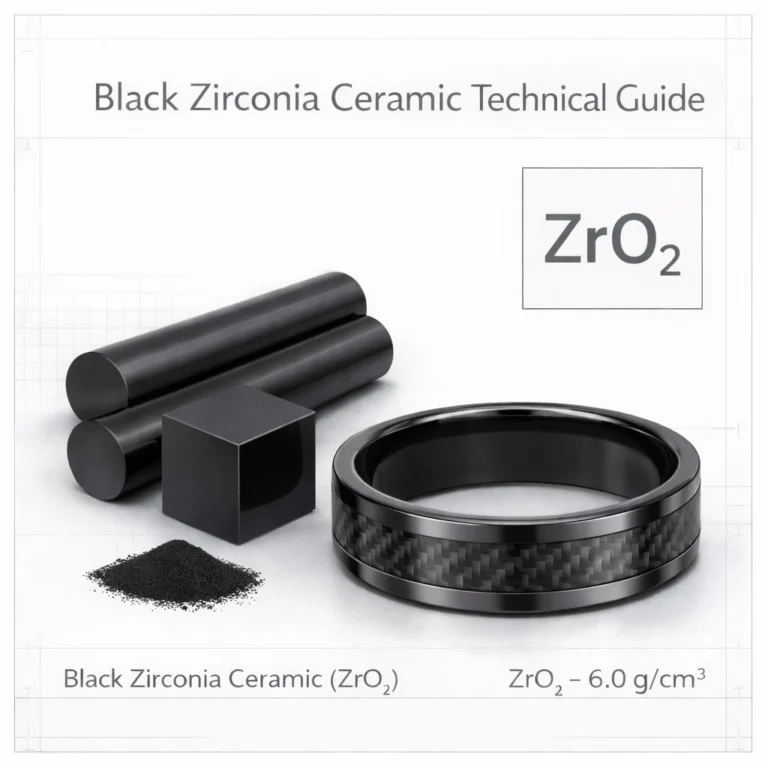
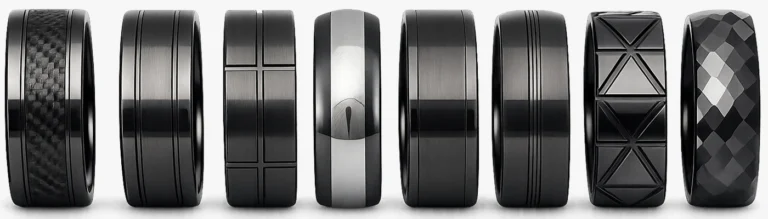
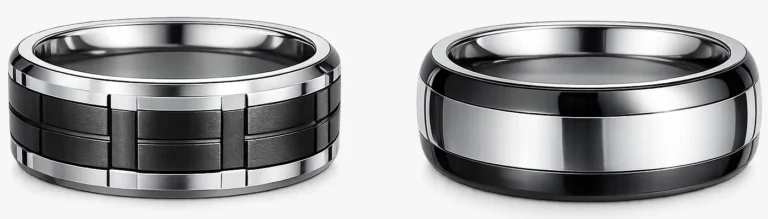
Black zirconia ceramic is black all the way through its structure. The colour is intrinsic to the ceramic body and is not applied as a surface treatment, coating, plating, or PVD layer. This distinction is important when comparing ceramic rings with surface-treated black metal rings, where colour is created by coatings over a lighter metal substrate.
Before being used for jewellery, the material has a long history in industrial and medical applications. Its adoption for black rings and zirconia wedding bands reflects the transfer of high-performance engineering ceramics into wearable form rather than decorative finishes applied to conventional metals.
Understanding what this ceramic is, and what it is not, provides the foundation for realistic expectations around wear behaviour, durability, and design trade-offs. For a practical overview, see our black zirconia ceramic pros and cons guide.
The zirconia ceramic material and its industrial context
Zirconia ceramic is defined by very high surface hardness, chemical inertness, thermal stability, and electrical insulation. These properties explain why the material has been used in demanding industrial environments long before being adapted for jewellery.
In aerospace and motorsport applications, including Formula 1, the ceramic is used in engineered components such as thermal barrier coatings, insulating parts, bearings, and wear components. These applications rely on the material’s ability to remain dimensionally stable under extreme temperatures and mechanical stress. They involve precision-engineered components rather than bulk ceramic forms analogous to jewellery rings.
Medical applications represent another major area where this ceramic is widely used. Zirconia-based materials are found in hip joint components, dental implants, and prosthetics. Their bioinert behaviour, resistance to corrosion, and long-term stability within the human body make them suitable for prolonged implantation.
The material is also used in industrial cutting tools and wear parts, where abrasion resistance and high compressive strength are required. These uses demonstrate why it is selected when predictable performance and chemical stability are prioritised over ductility.
This industrial background explains the performance characteristics that zirconia ceramic brings when adapted for jewellery applications such as black ceramic wedding rings and bands.
Zirconia ceramic properties relevant to jewellery
Composition and stabilisation
Ceramics of this type are typically stabilised using small amounts of yttria. Yttria stabilisation improves phase stability and toughness, reducing the risk of uncontrolled cracking. This approach is common across technical and medical ceramics, although exact formulations vary by supplier.
Regardless of stabilisation method, the material remains non-metallic, with no ductility and no capacity for plastic deformation.
Hardness and surface behaviour
Zirconia ceramic exhibits very high surface hardness. Depending on formulation and processing, its hardness is comparable to or exceeds many tungsten carbide formulations when assessed using Vickers hardness testing. On the Mohs scale, values typically fall around 8.5 to 9.
This high surface hardness explains the exceptional resistance to micro-abrasion seen in black ceramic rings. Everyday contact with keys, door handles, desk surfaces, and household objects does not readily produce visible scratches. Only materials harder than the ceramic, such as diamond, sapphire, or certain advanced carbides, are capable of scratching it under normal conditions.
Hardness and toughness are distinct properties. While the ceramic strongly resists surface scratching, it does not deform under load in the way metals do.
Toughness and failure mode
The material has high compressive strength but relatively low tensile toughness compared with metals. It has no ductility. Under sufficient point impact or concentrated stress, it can chip or fracture rather than bend.
This brittle failure mode is characteristic of ceramics. It does not indicate fragility in normal wear, but it defines the limits under extreme force.
Density and weight
The density is approximately 6.0 g/cm³. This places it heavier than titanium at around 4.5 g/cm³, but significantly lighter than tungsten carbide at approximately 15.6 g/cm³ and tantalum at about 16.6 g/cm³.
In practical terms, black zirconia ceramic rings have noticeable presence without the substantial weight associated with very dense metals.
Thermal and electrical properties
The ceramic is both a thermal and electrical insulator. Unlike metals, it does not readily conduct heat or electricity, contributing to a neutral feel against the skin across different temperatures.
The melting point is extremely high, in the region of 2700°C. While irrelevant to daily wear, this helps explain the material’s thermal stability during manufacture and use.
Chemical stability and biocompatibility
The ceramic is chemically inert under normal conditions. It does not corrode, tarnish, or react with water, sweat, or common household substances. This bioinert behaviour underpins its widespread use in medical implants.