Prompt writing is the real skill
Using AI well in business starts with knowing exactly what you want.
Prompt writing is not about shortcuts. Prompt writing is about precision. You must define the goal, the constraints, the tone, and what must be avoided. We often spend hours writing and refining a single prompt, then adjust it slightly each time that prompt framework is reused.
Good prompt writing forces clarity in business decisions. You have to understand your own work before any system can assist with it. Even when the output is not used directly, the thinking behind prompt writing improves structure and decision-making elsewhere in the business.
AI is not an easy option. It demands effort. Used carefully, it adds value to business workflows. Used casually, it produces generic results.
We use AI in business, but the work still starts with us
Everything we create starts internally.
Product descriptions, blog posts, photography, engraving layouts, and internal utilities are all produced by us first. AI in business is introduced later, usually to help refine, sense-check, or remove friction.
We deliberately avoid letting software generate finished content from scratch. That approach often produces text that sounds confident but lacks context or real experience. Instead, we write first and use assistance to review flow, repetition, or clarity.
Strong input leads to better output. The voice stays ours.
Using AI to refine blog posts
We do not ask AI to write our blogs.
Once a post is written, we may use assistance to highlight long sentences, repeated points, or awkward phrasing. AI in business can suggest clearer wording or a better order. Some suggestions are useful. Others are ignored.
Every change is reviewed manually. Facts are checked. Tone is preserved. Nothing is published unless it reflects our experience and something we are happy to stand behind.
Each article is also checked using similarity tools to ensure the content remains original and offers a fresh perspective rather than unintentionally echoing existing material. Grammar and readability checks are used to tidy, not rewrite. The finished blog is still our own work.
Using AI to write and refine code
We write a large amount of our own website code. This includes layout changes, engraving previews, calculators, and internal utilities.
AI tools are most useful when problems are broken into small parts. Feeding large blocks of code into them rarely works well. Focusing on one function or issue at a time does.
A simple example is an HTML link builder we created after realising how often we were writing anchor tags by hand. Using this approach to help structure the logic, we built a small tool that generates clean links in seconds. It now saves time every day in our wider business workflow.
The ideas, requirements, and testing remain human. The software helps with debugging and refinement, not ownership.
Editing images in-house, step by step
Product photography is demanding. Large collections still require professional shoots. That has not changed.
For smaller jobs, AI can assist the learning process. If an image feels too dark or unbalanced, we may ask for guidance on what adjustment to try in editing software. We apply the change manually, review it, and repeat if needed.
This back-and-forth improves our editing skills while producing usable images more quickly. AI in business supports the workflow. It does not replace it.
AI-generated visuals and mock-ups
Although we never use AI for product photography, we do use AI tools for mock-ups and illustrative visuals.
These are clearly separated from real product images. They are used to show context or explain ideas, such as how a ring might sit on a thumb or how an engraving layout could look.
We base these visuals on real products so proportions and details are accurate. They are never used to represent an item for sale.
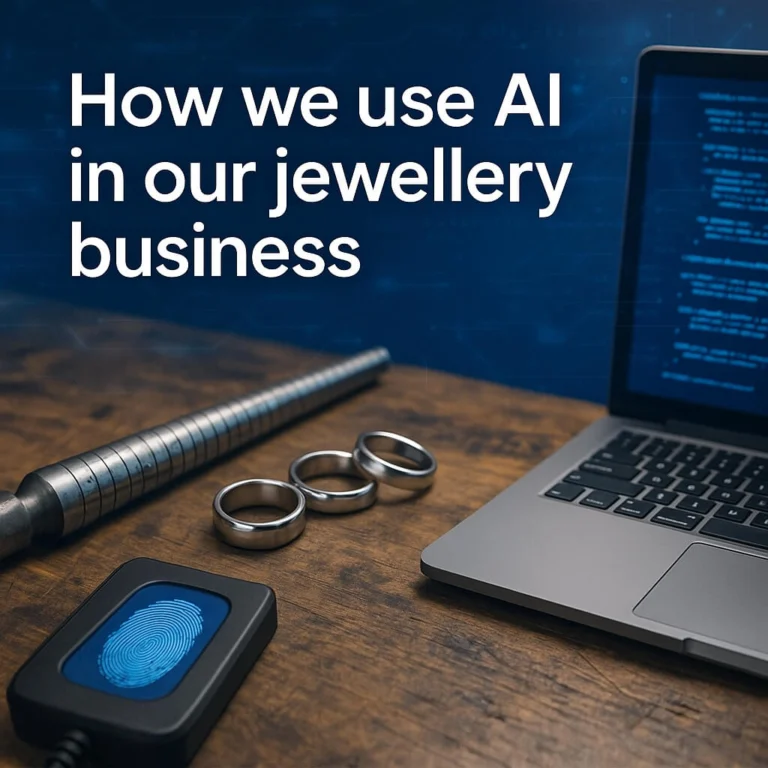
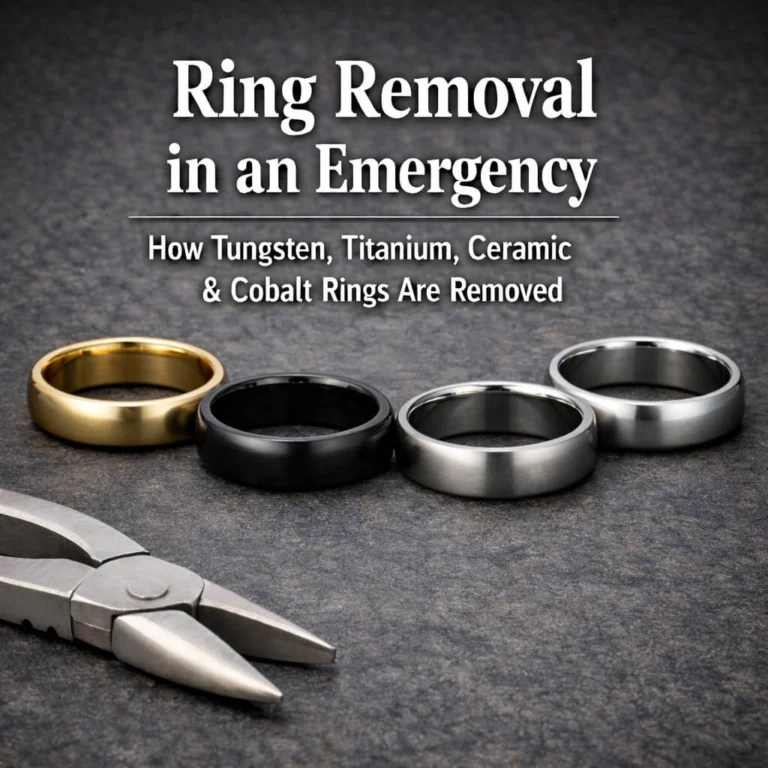
All images used in this blog are AI generated and used for illustration only.
Building tools for customers and other jewellers
One of the most practical uses of AI in business is tool development.
We build interactive utilities such as fingerprint cleaners, Morse code converters, symbol previews, and handwriting preparation tools. These are written in JavaScript and HTML. The ideas and interface design are ours.
AI tools help when code behaves unexpectedly or needs to work across browsers. We then test, refine, and often rewrite parts manually based on what we learn.
Several of these utilities are shared with other jewellers. That helps the wider trade and improves standards across the industry.
Using AI around engraving, not instead of it
AI never engraves jewellery for us.
Engraving is always set up, tested, and carried out manually using our equipment. Where AI tools help is in preparation. For example, when working with a new material, we may use AI in business research to identify sensible starting points for laser settings.
These are treated as rough guides only. Final settings are always determined through testing and adjustment on the machine. The engraving outcome is controlled by us, not software.
AI helps reduce guesswork. It does not replace skill or judgement.
The AI tools we actually use
People often ask what we think is the best AI in business. The honest answer is that there is no fixed winner. AI tools change quickly and often leapfrog each other. What works best depends on the task.
These are the AI tools we currently use and how they fit into our wider business workflow.
ChatGPT
Our main day-to-day system. Used for internal content review, restructuring drafts, checking clarity, debugging code, and developing internal utilities.
Gemini
Used mainly as a second opinion. Helpful for critique, sense-checking, and alternative viewpoints.
Claude
Used for focused analysis and drilling down into specific problems where detail matters.
Replit
Used for heavier coding work when required. Subscribed to on a task-by-task basis.
DeepSeek
Used occasionally for comparison and testing.
Adobe Photoshop generative features
Used selectively to assist with image editing and learning workflows, never for product photography.
We pay for ChatGPT and Claude on an ongoing basis. Other platforms are used as needed. This flexible approach reflects how quickly AI in business evolves.
What matters more than the platform is how it is used.
Would we trust AI to run the business
No.
We use AI in business daily, but we do not trust it to handle customer emails, orders, or decisions. Customers expect clear, human responses from someone who understands their order and cares about the outcome.
Most people have experienced automated systems that solve nothing and send you in circles. These systems will improve, but they are not there yet.
For us, personal contact remains essential.
Using AI for social media and experiments
Social media often comes second to workshop work.
AI helps with starting points. It might suggest a caption idea or a basic layout. Everything is edited before publishing.
We also experiment with AI-generated visuals for banners or blog headers. Accuracy is always checked, especially where ring details matter.
Checking answers because AI gets things wrong
AI is fast, but it often guesses.
We use AI in business for quick research across sizing, fonts, materials, engraving settings, and CSS issues. Every answer is checked. If two systems give noticeably different responses, we slow down and verify manually.
AI can admit mistakes when challenged. That alone is a reminder to treat it as an assistant, not an authority.
How AI in business is changing website traffic
Our own habits have changed. We often ask AI questions instead of searching. Many others do the same.
That shift reduces traditional website traffic. Direct answers and summaries mean fewer clicks. At the same time, we are seeing customers arrive after using AI to research materials, sizing, or engraving ideas.
It feels like a transition rather than a decline.
For us, the approach stays the same.
Do the work properly first.
Then use AI to support it.





 Winner of King award for Alternative Metal Rings
 Winner of Theo Paphitis (Dragons Den) Small Business Award
 We are fully pci-dss compliant
 Security Headers rate us A+ for website security
 We are registered with the ico for data protection
 We are members of The Guild of Jewellery Designers