

Black Ceramic Rings Buying Guide
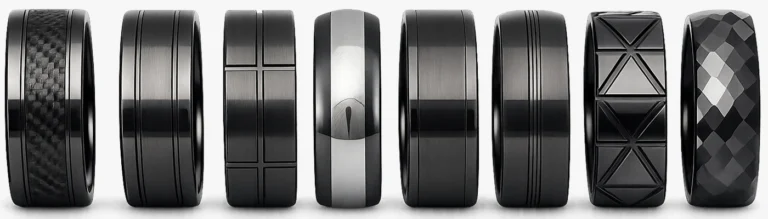
- Black zirconia ceramic is colour-through, meaning the black runs throughout the entire material rather than being a coating, plating, or PVD layer over a lighter core.
- With a surface hardness of around 8.5 to 9 on the Mohs scale, black ceramic rings are highly resistant to everyday scratching from common objects.
- Zirconia ceramic is chemically inert, hypoallergenic, and biocompatible, and is from the same family of materials used in medical components such as hip joints and dental implants.
- In terms of weight, zirconia ceramic is heavier than titanium but significantly lighter than tungsten carbide or tantalum, giving a solid feel without excessive density.
- As a thermal insulator, ceramic does not tend to feel cold when first put on, unlike metal rings which can feel noticeably cold in the morning.
- The collection is available in UK sizes J to Z+11, with widths from 4mm to 8mm across multiple designs.
- Black ceramic rings cannot be resized after manufacture, as the material cannot be stretched or reformed.
- As a non-metallic material with no ductility, ceramic can in rare cases chip or fracture under extreme point impact rather than bend.
Black Ceramic Rings Buying Guide
Black zirconia ceramic is a non-metallic, colour-through material that does not rely on coatings or surface treatments for its black appearance. It is made from zirconium dioxide powder that is processed and sintered at very high temperature into a dense ceramic. It is not zirconium metal, and it does not behave like a metal.
The most significant practical difference between black ceramic rings and many other black wedding rings is that the colour runs through the entire material. It is not plating, not PVD, and not a surface layer over a lighter core. If the ring is ever scratched or damaged, there is no grey metal beneath to show through. This contrasts directly with black tungsten, black titanium, and black zirconium metal, all of which rely on surface treatments or oxide layers to create their dark finish.
With close to four decades as a working goldsmith and nearly 25 years specialising in alternative metals and ceramics, we have seen how different materials perform over years of daily wear. Many customers researching black rings for men or black ceramic rings for men are ultimately asking the same question: what is the best black wedding ring? The honest answer is that it depends on your priorities. If lasting black colour without coatings and high scratch resistance are at the top of your list, zirconia ceramic is worth looking at closely.
At Titan Jewellery, our zirconia ceramic rings are designed as everyday black wedding bands intended for long-term wear. This guide explains what you can realistically expect before you order.
Why choose black ceramic rings
Most people drawn to black ceramic wedding rings are looking for durability in daily wear, stable colour, and a modern, clean aesthetic.
Surface hardness is extremely high, typically around 8.5 to 9 on the Mohs scale. In practical terms, everyday contact with keys, door handles, desks, and household objects does not readily produce visible scratches. Only materials harder than the ceramic, such as diamond, sapphire, or certain advanced carbides, can scratch it under normal conditions. If you are wondering do ceramic rings scratch, routine daily activity rarely leaves marks.
This high hardness is what makes ceramic rings a genuine example of scratch resistant black rings. They are not indestructible, but compared with titanium or precious metals, they resist micro-abrasion exceptionally well.
Weight also plays a part in how a ring feels over time. Zirconia ceramic is heavier than titanium but significantly lighter than tungsten carbide or tantalum. On the finger, black ceramic rings feel solid without the dense weight associated with very heavy metals.
Skin safety matters for a ring worn every day. Zirconia ceramic is chemically inert and biocompatible. The same family of materials is used in hip joint components and dental implants. It does not corrode, tarnish, or react with water, sweat, or common household substances. For customers with sensitive skin, it is unlikely to cause any skin reaction.
Affordability is part of the appeal. Our black ceramic rings are priced between £55 and £70, depending on width and design. For customers comparing zirconia wedding bands with precious metals or coated alternatives, this makes them affordable without cutting corners on the material.
For readers who want the engineering detail behind zirconia ceramic, including stabilisation and sintering, our black zirconia ceramic technical guide goes into that depth.
Comparing Black Ceramic with Black Zirconium
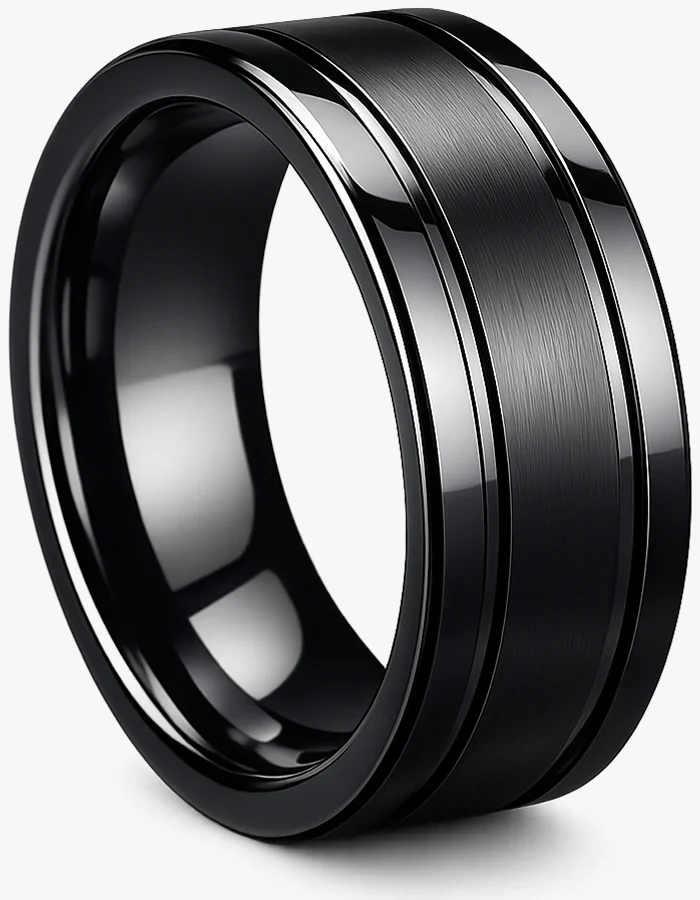
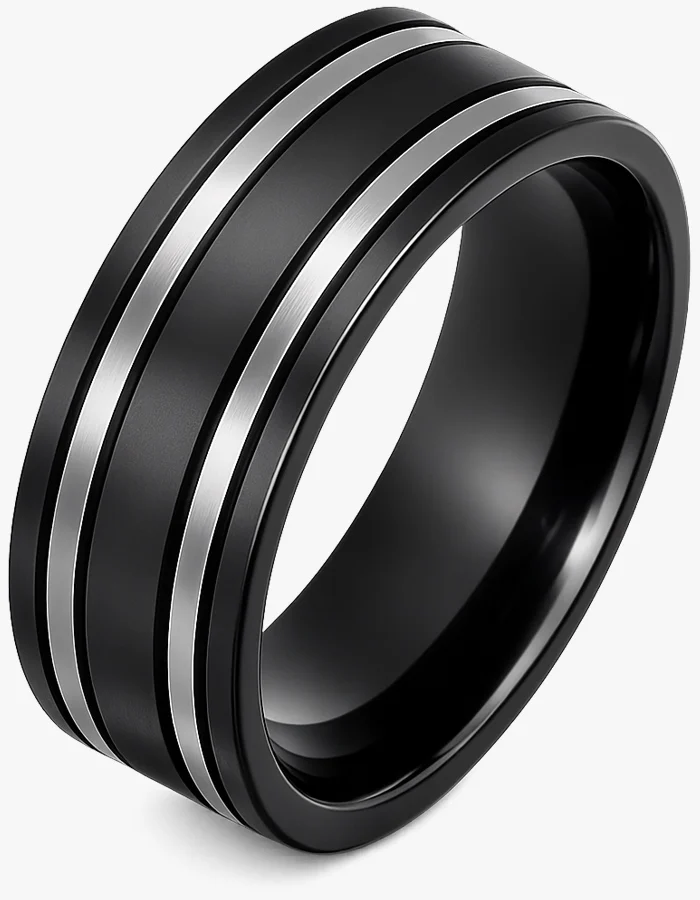
Black zirconia ceramic on the left, black zirconium metal on the right. Both are black rings, but they are fundamentally different materials. The ceramic is colour-through and non-metallic, so the entire ring is solid black with no underlying metal to reveal. The zirconium is a metal with a black oxide surface over natural grey metal beneath. Where the oxide is removed, the natural grey zirconium shows through, creating the two-tone contrast visible in the grey stripes. For a solid black ring with no contrasting colour, ceramic is the material. For a black ring with grey detail, zirconium offers that option.
What to expect from daily wear
When customers ask are ceramic rings durable, they are usually thinking about two things: scratching and breakage.
In terms of surface wear, black ceramic wedding rings perform extremely well. Polished finishes maintain crisp reflections. Brushed finishes retain their linear texture. Because the colour runs through the entire material, there is no surface layer to wear through and no contrasting metal beneath.
Ceramic is, however, a non-metallic material with no ductility. It does not bend or deform. Under sufficient point impact or concentrated force, it can chip or fracture rather than dent. Metals such as titanium will deform under force. Ceramic either withstands the impact or, if the force is high enough and localised enough, it fails.
In normal everyday use, breakage is rare. Across years of supplying ceramic rings, we see very few genuine impact failures, and when they do occur they are usually linked to a sharp blow against a hard edge or a high-energy accident rather than routine activity. So, can ceramic rings break? Yes, they can, but not under typical daily wear such as typing, driving, or working at a desk.
If a ring is genuinely damaged through accidental impact, we will replace the first accidental breakage free of charge on a like for like basis. That means the same ring, same size, and same finish. No changes are permitted. Replacement is at our discretion and applies to genuine accidental damage only.
In an emergency situation, ceramic rings can be removed using standard locking pliers or vice grip tools available in hospitals and emergency departments. The ring is cracked under controlled pressure rather than cut. This is a standard procedure and emergency departments are familiar with it.
Finish choice affects appearance rather than strength. A polished black wedding band shows deeper reflections and may show fingerprints more readily. A brushed finish diffuses reflections and can appear slightly more understated in daily wear. Both offer the same structural performance.
Important things to know before ordering
Black ceramic rings cannot be resized after manufacture. Zirconia ceramic cannot be stretched, compressed, or reformed.
This material is also a thermal insulator. In practical terms, it does not tend to feel cold when you first put it on in the morning in the way a metal ring can. It is a small difference, but one customers often notice.
Accurate sizing before ordering is essential. Our range is available in UK sizes J to Z+11. If the size ordered is not correct, we offer a free exchange to resolve sizing issues.
Widths in our collection run from 4mm to 8mm. Designs include plain polished and brushed bands, chamfered edge profiles, tramline detailing, grid patterns, faceted surfaces, and selected models with carbon fibre or tungsten inlays. All rings are held in stock with free UK delivery.
If you are comparing ceramic rings with other materials, understanding these fixed limitations in advance avoids disappointment later.
How black ceramic rings compare with other materials
Customers frequently compare ceramic vs tungsten, ceramic vs titanium, or ceramic vs zirconium when deciding between black wedding rings.
Compared with black tungsten, zirconia ceramic offers similar levels of scratch resistance and the same non-resizable limitation. The key difference is colour construction. Black tungsten typically relies on an IP or PVD coated surface over grey tungsten carbide. If that coating is deeply scratched, grey metal can show beneath. Zirconia ceramic remains black throughout.
When looking at ceramic vs zirconium, the materials are fundamentally different. Black zirconium is a metal with a black oxide layer formed on its surface. Deep scratches can reveal the underlying silver-grey metal, and zirconium metal can dent under impact. Ceramic does not dent. It either resists the force or fractures. For anyone wanting a contrast of black and natural grey tones in a single design, our black zirconium rings provide that two tone effect using oxidised and natural metal.
Against titanium, the contrast is straightforward. Titanium is lightweight and tough but scratches readily in daily wear. Zirconia ceramic is far more resistant to visible surface scratching. Titanium will deform under impact. Ceramic will not deform, but under sufficient force it can break.
None of these materials is objectively better than the others. The right choice depends on whether you prioritise colour permanence, impact tolerance, weight, or the ability to resize.
Black ceramic rings pros and cons
Pros
Colour runs through the entire material, so there is no surface coating to wear away.
Exceptional resistance to everyday surface scratching.
Lighter than tungsten carbide while still feeling solid on the finger. It has presence without excessive weight.
Hypoallergenic and biocompatible, making it suitable for sensitive skin.
Affordable compared with many traditional precious metals.
Minimal maintenance. Clean with soapy water and it is usually good to go.
Cons
Cannot be resized once manufactured.
Can chip or fracture under extreme point impact. This is uncommon in normal daily wear, but it is a characteristic of ceramic rather than metal.
Limited to black colour only.
Not suitable if you prefer a material that can bend rather than break under force.
Is a black ceramic ring right for you
Black ceramic rings are different from most black wedding bands on the market. They offer consistent, colour-through black and strong resistance to everyday scratching. They are comfortable to wear, skin-safe, and priced accessibly.
They cannot be resized, and under extreme impact they can fracture rather than bend. Those are characteristics of the material itself, not shortcomings, and they are worth knowing before you order.
If you want black ceramic rings that stay black without relying on coatings, and you value scratch resistance over the ability to resize, this is a material we have supplied for years with consistently positive customer feedback.