

Court Profile
Also known as: traditional court, classic court, rounded court
The court profile is the classic British wedding ring shape and the traditional wedding ring shape most people picture first. Both the exterior and interior are domed, creating a lens-shaped wedding ring cross section. A court profile wedding ring presents a continuous curve from edge to edge on the outside and a matching comfort curve inside. It is often the starting point in any ring profile guide because the shape is familiar, widely available, and generally comfortable across a wide range of hands.
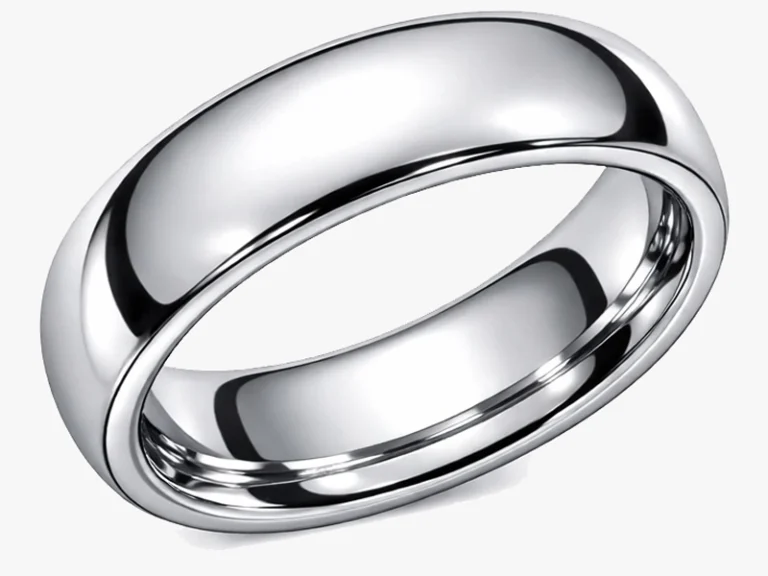
Polished court rings produce a curved highlight stripe that moves as the hand turns. On narrower widths the dome appears more pronounced. As the ring becomes wider, that same curvature spreads across more metal, so the top can look flatter than expected even though the profile is still rounded.
The interior curve reduces edge pressure and helps the ring travel over the knuckle with less resistance than a flat interior. On fingers where the knuckle is noticeably larger than the base, that difference is easy to feel. The contact area at the base of the finger is also reduced compared with a flat interior, so rotation can increase on tapered fingers. Mens court widths are often chosen around 5mm to 7mm, while womens court widths are often 3mm to 5mm, but hand size and preference matter more than the label.
Because the inside surface curves away towards the edges, usable engraving height is reduced compared with a flat interior. Taller lettering will begin to soften near the top and bottom where the curve becomes more pronounced.
A court wedding ring remains popular because it combines a traditional look with an easy-on feel. The main thing to understand is that width changes how rounded the ring appears and how stable it feels once on the finger.
Shallow Court Profile
Also known as: slight court, easy fit
The shallow court profile keeps the domed exterior of a court but flattens most of the interior, easing only the inner edges. The wedding ring cross section shows a rounded top and a flatter base with softened corners. Its interior shape sits between a full rounded court and a D-shape.
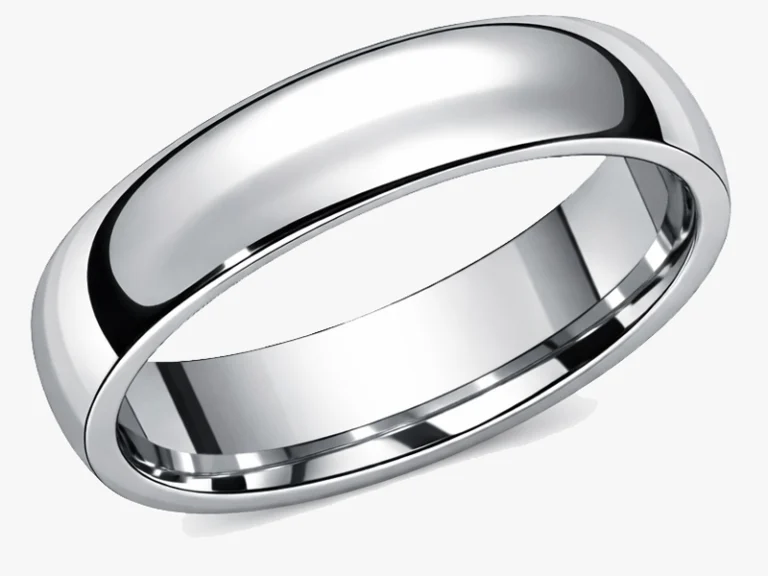
From the outside it reads as a court profile ring. The same curved highlight runs around the surface on polished finishes. The difference only becomes clear when the ring is examined from the inside or worn next to a full comfort curve.
The flatter interior centre increases contact against the finger. That extra contact tends to reduce rotation compared with a fully domed interior. At the same time, the eased inner edges remove the hard corner that can develop on a completely flat bore. On wider bands, that softened edge becomes more noticeable during gripping or when fingers swell.
Engraving sits on a broader level strip than on a full court, so more of the interior height can be used before the surface starts to curve away. It still offers less space than a completely flat interior, but more than a fully domed one.
Among wedding ring profiles, shallow court is chosen by people who want the rounded court look but prefer a more planted feel at the base of the finger. It gives up some of the glide over the knuckle that defines a full comfort curve, but gains stability.
D-Shape Profile
Also known as: D-section, half-round
The D-shape profile has a domed exterior and a flat interior, creating a wedding ring cross section shaped like a capital D lying on its back. The term D-shape simply describes that cross section: rounded on top, flat on the bottom.
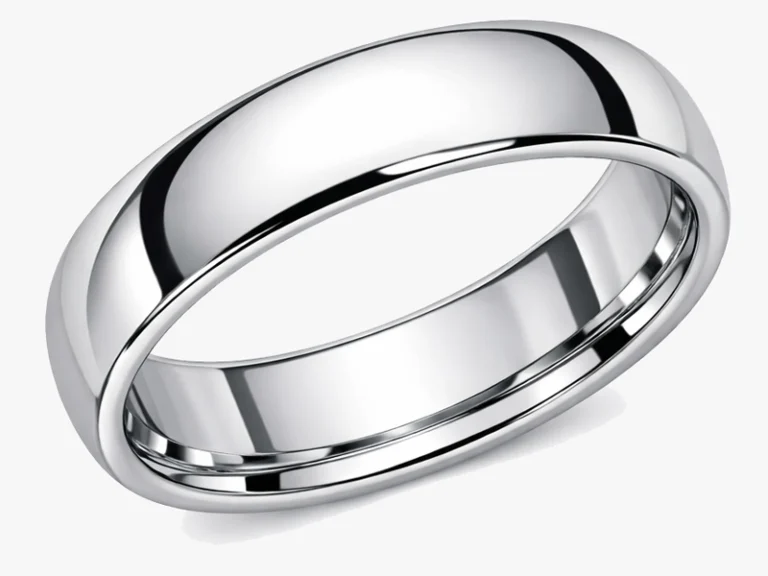
The flat interior gives full contact from edge to edge. That contact often feels secure and reduces movement during the day. At the same nominal diameter, a D-shape can feel tighter than a comfort fit design because more of the interior presses evenly against the finger.
Corner pressure becomes more noticeable as width increases. On wider D-shape rings, the inner corners can press into softer tissue during gripping. That is where the common complaint about wide D-shapes biting at the edges comes from.
The flat interior offers generous engraving space. Because the surface stays level across the width, taller fonts remain clearer and more consistent from top to bottom.
D-shape remains one of the older wedding ring profiles still in regular use. It provides a traditional exterior with a firm interior feel. The main consideration is how the flat inner corners behave at wider widths and over larger knuckles.
Flat Profile
Also known as: flat band, flat wedding ring, pipe cut
The flat profile forms a rectangular wedding ring cross section. The exterior is completely flat, the interior is completely flat, and the edges meet at near right angles unless separately softened. It is the most angular of common ring profiles.
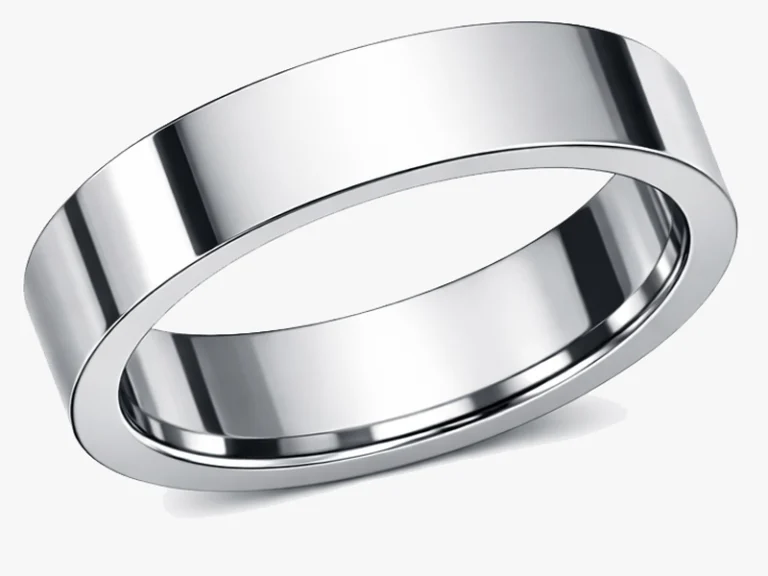
A polished flat band reflects light as a broad, even panel rather than a moving curved stripe. Because the full width of the top surface faces outward, a flat profile often appears slightly wider than a domed ring of the same measured width.
The fully flat interior maximises contact with the finger. In narrow widths this can feel stable and settled. As the band becomes wider, the inner corners begin to press more clearly during gripping or when fingers swell. There is no interior curve to relieve that pressure.
Engraving is uncomplicated on a flat interior. The level surface allows more of the interior height to be used before letters begin to distort, making it suitable for taller inscriptions.
Flat profile suits those who prefer crisp lines and a modern outline. The sensation on the finger is more direct than on comfort fit designs, especially as the width increases.
Flat Court Profile
Also known as: comfort fit, flat comfort, Euro comfort
The flat court profile combines a flat exterior with a domed interior. The wedding ring cross section shows a straight top surface and a curved inner surface. In many alternative metal ranges, this is the profile referred to as a comfort fit wedding ring.
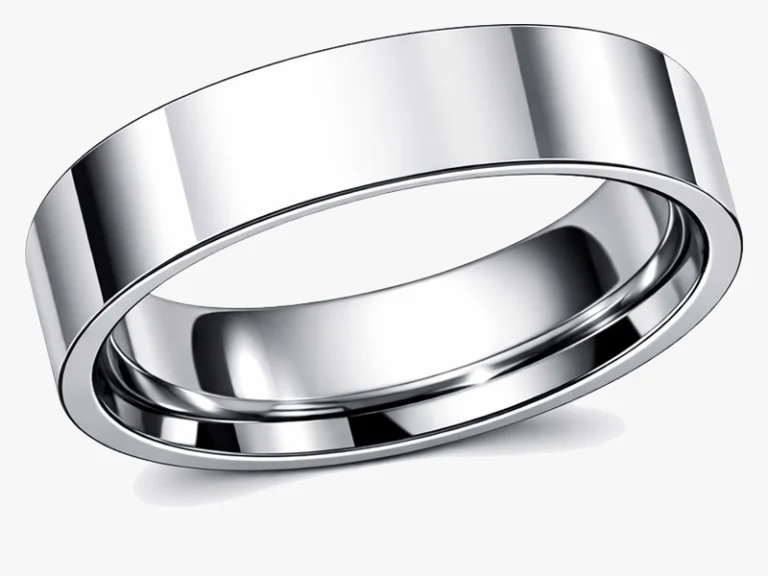
The flat exterior gives a clean, contemporary look. On polished versions, light reflects as a broad band rather than a curved highlight. Brushed or satin finishes appear consistent because the surface is not rolling over a dome.
Inside, the comfort curve reduces edge pressure. That interior curve is what comfort fit actually means: less edge pressure against the finger rather than a larger ring size. Because the surface curves away towards the edges, usable engraving height is reduced compared with a flat interior.
Movement over the knuckle is usually easier than with flat interior designs. The ring can rotate more readily on tapered fingers because there is less flat contact holding it in place. A slightly loose size will spin more, so how snug the size is matters.
Flat court is often chosen as a balance between modern exterior styling and everyday comfort.
Blended Court Profile
Also known as: heavy court, deep court, Euro court
The blended court profile is a development of the rounded court designed to maintain a pronounced dome on wider rings. Both the exterior and interior are domed, but overall depth is increased compared with a standard court at the same width.
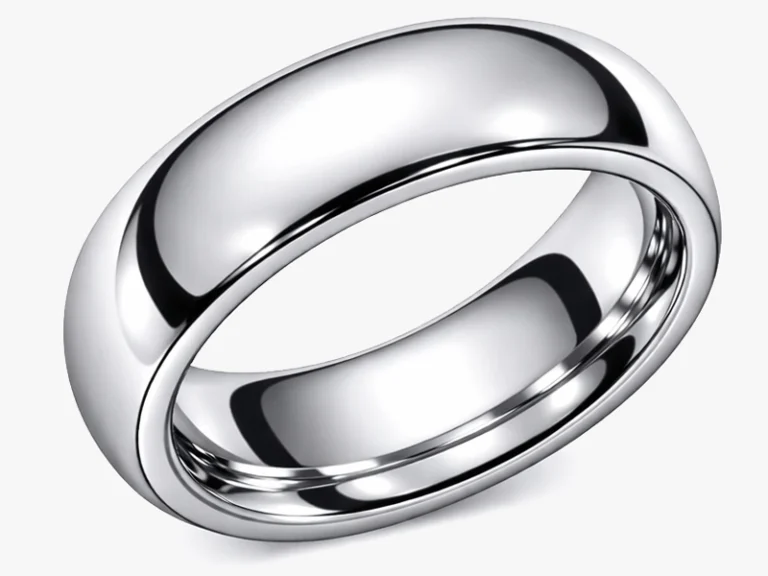
That additional depth preserves the visible curvature of the top surface so it does not read as flattened on wider bands. The highlight on a polished blended court remains clearly curved even as the width increases.
It still feels like a comfort fit because the inside is fully domed. The increased depth means the ring sits slightly taller off the finger. During gripping, that extra height can feel more substantial. Engraving height is comparable to other domed interiors of the same width.
Blended court is chosen when appearance is the priority on wider rings and a clearly rounded top is desired. The added depth changes the visual and tactile presence without altering the basic comfort curve. View our blended court tungsten wedding rings.
Bevelled Court Profile
Also known as: chamfered court, bevelled edge ring
The bevelled court profile combines a flat exterior centre with angled bevels at both outer edges and a domed interior. The top surface is divided into three planes: a central flat and two sloping edge facets.
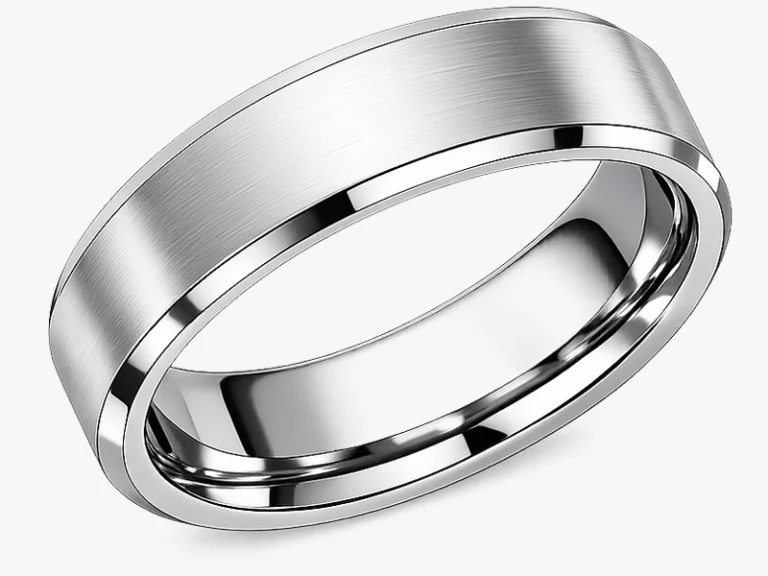
The bevels create distinct reflection lines that frame the flat centre. On polished finishes, those angled planes catch light sharply. On brushed finishes, the angles are still visible because each plane reflects light differently.
Inside, the comfort curve is unchanged. The angled outer edges can feel less abrupt against neighbouring fingers compared with a sharp flat profile, even though the inside shape remains curved.
Bevelled court offers visual definition without abandoning comfort fit principles. It appeals to those who prefer structured lines over a continuous dome while retaining a curved interior.