Free UK Delivery | 30 Days Return Policy

Zirconium Metal Technical Reference Guide

What is Zirconium Metal?

What is Zirconium Metal?

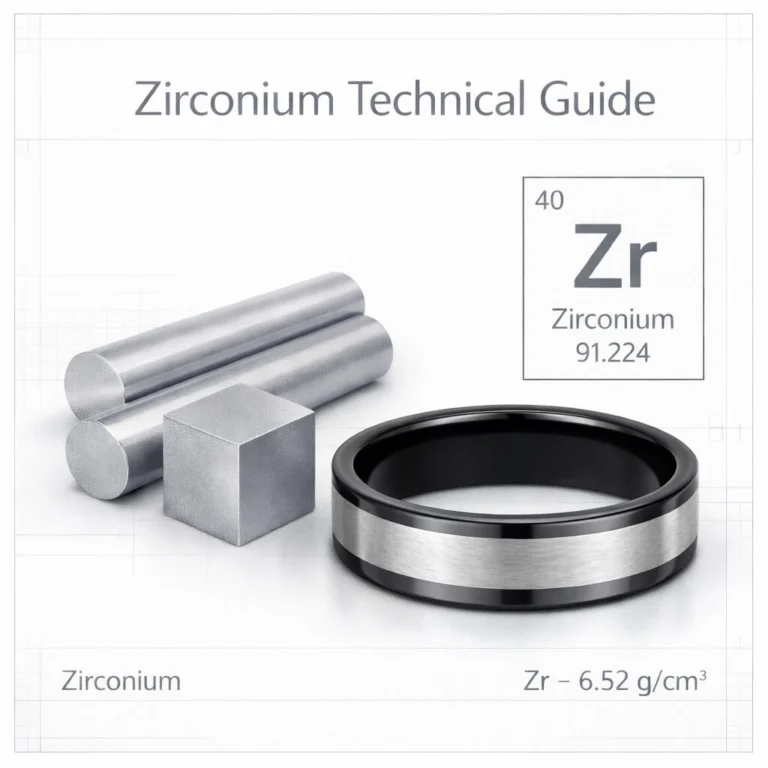
Zirconium metal is a transition metal with the chemical symbol Zr and atomic number 40. In its natural metallic state, it has a silver-grey appearance similar to titanium, but it differs in both industrial role and surface behaviour. Despite sharing a name, zirconium metal is fundamentally different from black zirconia ceramic, which is a non-metallic ceramic material formed from zirconium dioxide.

Zirconium occurs naturally in mineral deposits, primarily as zircon (zirconium silicate). Before it can be used in engineering or jewellery applications, the element must be chemically separated, refined, and processed into metallic form. The resulting metal exhibits a combination of corrosion resistance, biocompatibility, and high-temperature stability that has led to widespread use in demanding industrial environments.

Quick Summary

In jewellery, rings made from this metal are used primarily where controlled surface oxidation is required. The ability of the material to form a hard black oxide layer distinguishes it from many other grey metals used for rings.

Understanding what zirconium metal is, and what it is not, is essential for setting realistic expectations around appearance, wear behaviour, and long-term refinishing.


The zirconium metal element and its industrial context

The metal has been used extensively in industry long before being adapted for jewellery. This broader industrial relevance provides important context for understanding its behaviour when worn as a ring.

Nuclear power industry

Approximately 90% of global zirconium production is used in the nuclear power industry. Zirconium alloys, commonly referred to as zircaloys, are used as fuel rod cladding and structural components inside nuclear reactors. This application relies on several critical properties:

  • Extremely low neutron absorption cross-section

  • Excellent corrosion resistance in high-temperature water and steam

  • Structural stability at temperatures exceeding 750°C

These characteristics allow components made from this metal to operate safely in reactor environments where many other materials would degrade rapidly.

Aerospace and high-temperature engineering

The material is used in aerospace and high-temperature engineering applications where strength-to-weight ratio and thermal stability are important. With a melting point of approximately 1855°C, it maintains structural integrity at temperatures beyond the limits of many lightweight metals.

In certain extreme environments, zirconium alloys outperform titanium in heat resistance while remaining significantly lighter than dense refractory metals.

Chemical processing

Zirconium is widely used in chemical processing equipment, including heat exchangers, valves, and piping systems. Its resistance to acids, alkalis, and corrosive media makes it suitable for long-term use in harsh chemical environments.

Medical applications

Zirconium is biocompatible and non-toxic. Zirconium-based materials are used in medical implants, dental prosthetics, and surgical instruments. This biocompatibility underpins the use of rings intended for prolonged skin contact.

This industrial background explains why the metal behaves predictably under conditions involving heat, moisture, and chemical exposure when adapted for jewellery.

5 Black Zirconium Rings - Zirconium metal black wedding rings
A selection of our Black Zirconium Rings

Zirconium metal properties relevant to jewellery

Density and weight

The metal has a density of approximately 6.52 g/cm³. This places it slightly heavier than titanium, which has a density of around 4.5 g/cm³, but significantly lighter than materials such as tungsten carbide or tantalum.

In ring form, this translates to a noticeable but not heavy feel on the hand. The weight difference between rings made from zirconium and titanium is perceptible but modest, and far removed from the substantial mass associated with very dense metals.

Corrosion resistance

The metal exhibits excellent corrosion resistance. In normal environments, it forms a stable oxide film that protects the underlying structure from further reaction. This behaviour contributes to long-term stability in contact with water, sweat, and everyday chemicals.

Biocompatibility and hypoallergenic behaviour

Zirconium is hypoallergenic. It does not release ions that commonly trigger skin reactions and is considered safe for wear by individuals with metal sensitivities. Its medical use supports this behaviour, as the material has been proven suitable for long-term implantation.

Mechanical behaviour

The material is ductile compared with ceramic materials. Under load, it is capable of deforming rather than fracturing. This ductility distinguishes it from brittle materials such as black zirconia ceramic or tungsten carbide.

Under heavy manual work or high point loads, surface damage is possible, as with most jewellery materials. However, the metal itself is resistant to catastrophic failure such as cracking or shattering.


Zirconium metal for jewellery and ring design

Natural grey zirconium

In its unoxidised state, natural zirconium has a silver-grey appearance similar to titanium. This natural zirconium state serves as the base material for all zirconium rings.

Natural zirconium can be polished or brushed, producing finishes familiar to those accustomed to titanium jewellery. In this state, the metal is softer than its oxidised surface form.

Black zirconium and surface oxidation

Black zirconium is created through a controlled high-temperature oxidation process. When the metal is heated for extended periods under specific conditions, oxygen diffuses into the surface and reacts to form a layer of zirconium oxide.

The black zirconium oxide surface exhibits a Mohs hardness of approximately 9. This hardness applies to the oxide layer itself, not the underlying grey metal. The oxide is chemically bonded to the base material and is far more durable than applied coatings.

This process differs fundamentally from plating, PVD, or paint-based finishes. The black colour is the result of a chemical transformation of the surface rather than a separate layer applied on top.

Two-tone zirconium rings

Two-tone rings are produced by machining through areas of the black oxide layer to expose the underlying grey metal. This contrast arises from machining through the oxide layer, exposing the underlying grey metal.

The result is a stable visual contrast between black oxide regions and natural grey zirconium. Over time, the black areas remain black, and the grey areas remain grey, provided the oxide layer is not removed through wear or refinishing.

All-black clarification

Plain all-black zirconium rings are not offered. Where an all-black appearance with no grey exposure is required, black zirconia ceramic is more suitable due to its colour-through structure.

Engraving Behaviour

Engraving on grey zirconium

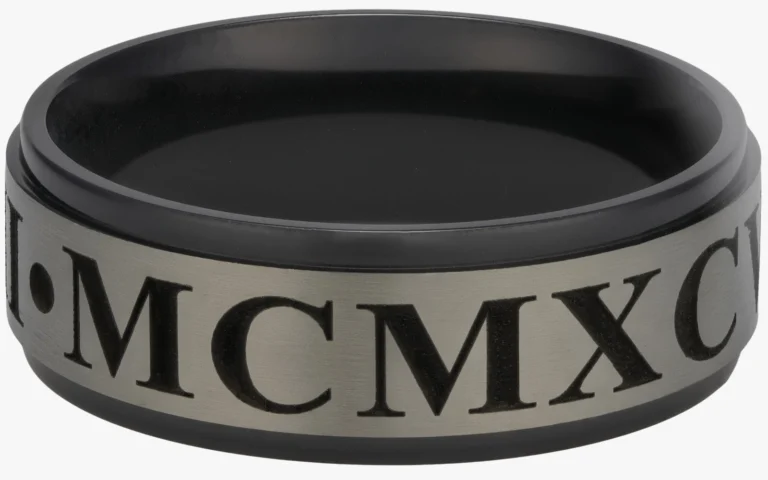
Laser engraving on grey zirconium produces dark marks with strong contrast against the silver-grey surface. This makes engraving highly legible and visually distinct. Depth, clarity, and consistency are comparable to other grey metals used for jewellery.

8mm Black Zirconium Ring with Brushed Natural Flat Band with custom roman numeral engraving.

Engraving behaviour

Engraving on grey zirconium

Laser engraving on grey zirconium produces dark marks with strong contrast against the silver-grey surface. This makes engraving highly legible and visually distinct. Depth, clarity, and consistency are comparable to other grey metals used for jewellery.

Engraving on black zirconium

Engraving on black zirconium produces black-on-black results. The engraving is subtle and may be difficult to see under diffuse lighting. Under direct light, engraved text becomes more legible as reflections highlight depth variations.

This effect results from how the laser interacts with the oxide layer and underlying metal. Some wearers prefer this understated appearance, while others may find it insufficiently visible.


Working with zirconium metal in the workshop context

Oxidation process overview

The black surface on these rings is created by heating the metal at high temperature for extended periods. During this process, oxygen reacts with the surface to form zirconium oxide. The transformation is chemical rather than physical.

Temperature, duration, and atmosphere control the depth and consistency of the oxide layer. Once formed, the oxide is integral to the surface.

Apparent scratches and metal transfer

When black zirconium contacts softer metals, marks may appear that resemble scratches. In many cases, this is metal transfer rather than damage to the oxide layer.

These marks can often be removed using suitable scouring pads, revealing the original black surface beneath. True scratches occur when the oxide layer itself is disrupted.

Ring sizing and availability

Zirconium rings of this type cannot be resized after manufacture. Cutting and resizing disrupts the oxide layer, and consistent re-oxidation cannot be achieved once the ring geometry is altered.

They are manufactured to final size. Accurate sizing before manufacture is essential. Sizes are available from J to Z+11. An exchange policy exists to address sizing issues arising from this limitation.

Refinishing options

Natural zirconium can be refinished in the same manner as other metals. The black oxide surface can be polished lightly, but deep damage that exposes grey metal will result in permanent two-tone appearance.

Industrial re-oxidation is possible but not part of typical workshop refinishing processes. Many wearers accept exposed grey areas as part of the ring’s long-term character.


Combustion and flammability context

In bulk solid form, zirconium presents no flammability concerns. The ignition temperature of solid zirconium is approximately 1300–1400°C, well beyond any conditions encountered in jewellery wear.

In powdered form with very fine particle size, zirconium can be pyrophoric. This behaviour is relevant to industrial machining environments and powder handling, not finished zirconium metal rings.


Zirconium metal compared to other materials

Zirconium metal vs titanium

Zirconium and titanium share similar appearance in their natural grey states. Zirconium is slightly heavier but offers higher temperature resistance. Both metals form oxide layers naturally and are hypoallergenic.

Zirconium differs in its ability to form a stable black oxide layer with high surface hardness, whereas titanium oxide produces colour effects rather than deep black.

Zirconium metal vs black zirconia ceramic

Zirconium metal and black zirconia ceramic are fundamentally different materials. Zirconium is a ductile metal with a surface oxide. Zirconia ceramic is a non-metallic ceramic material throughout.

Zirconium can be two-tone. Zirconia ceramic is uniformly black. Zirconium deforms under impact. Zirconia ceramic fractures.

Zirconium metal vs tantalum

Tantalum is significantly denser than zirconium and remains grey in appearance. Zirconium offers black surface transformation that tantalum does not.

Both metals are corrosion resistant and biocompatible, but their visual and weight characteristics differ substantially.

Zirconium metal vs tungsten carbide

Tungsten carbide is much denser and brittle. Black tungsten relies on surface coatings that can wear. Black zirconium is formed through chemical oxidation and is integral to the metal surface.

Zirconium offers greater ductility and the ability to create two-tone designs.


Wear and refinishing expectations

Zirconium rings perform well under normal wear. The black oxide surface provides high scratch resistance, while the underlying metal offers toughness.

Surface damage is possible under high point loads, and exposed grey areas may develop over time. Structural failure is unlikely.

Zirconium metal offers a balance of durability, visual contrast, and long-term stability when its properties are understood and respected.


UK Based Stock

We dispatch directly from our Kent Location.

Fast Dispatch

Stock orders placed by 1pm usually sent same working day

Easy Returns

30 day no quibble refund or exchange policy

Expert Support

Speak to our Goldsmith with over 35 years jewellery experience