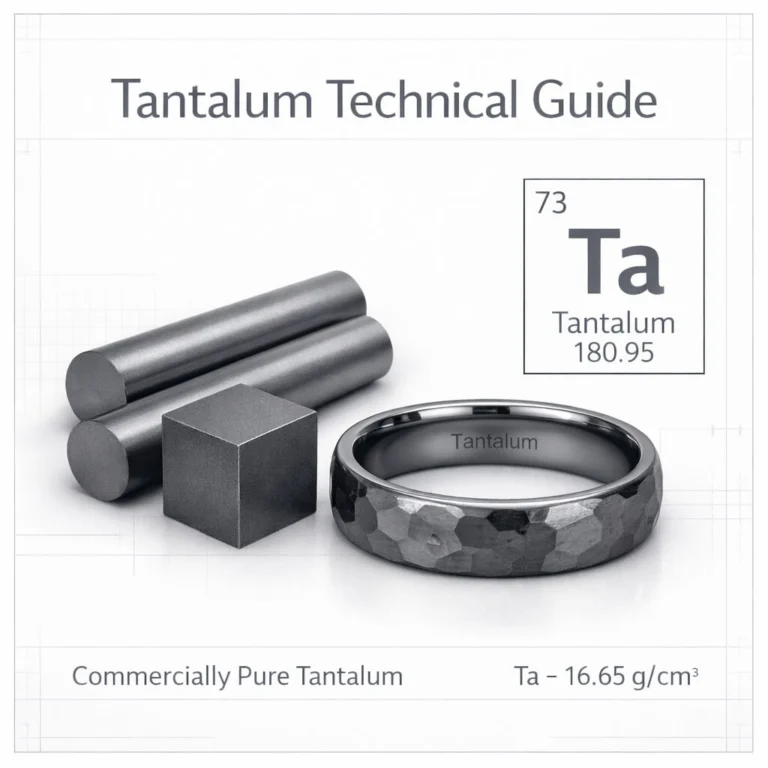
From a geological standpoint, tantalum is scarce in the Earth’s crust. Its availability is limited when compared with common structural metals. Despite this, tantalum metal is in constant demand due to its physical and chemical characteristics, particularly in industrial and medical applications. This demand is driven by performance requirements rather than consumer trends.
Understanding what tantalum is and how it behaves helps explain why it performs the way it does when used for jewellery, especially for rings intended for long-term wear. For a practical overview of advantages and limitations, see our tantalum wedding rings pros and cons guide.
The tantalum element and its industrial context
The tantalum element is defined by a combination of high temperature stability, corrosion resistance, and predictable surface chemistry. These characteristics explain why tantalum metal is widely used outside jewellery long before it appears on a jeweller’s bench.
One of the largest tantalum uses is in the electronics industry, particularly in capacitors. Tantalum capacitors rely on the metal’s ability to form a stable oxide layer with reliable electrical properties. These components are produced at very large scale for consumer electronics, automotive systems, and industrial equipment.
Tantalum is also used in medical implants and surgical tools. Its corrosion resistance and biocompatibility allow it to remain stable within the human body for extended periods. These industrial and medical uses place consistent demand on tantalum metal supply, independent of jewellery production.
For a jewellery workshop, this background is not academic. It directly informs how tantalum behaves during machining, finishing, engraving, and stone setting.
Tantalum properties relevant to jewellery
Density and weight
Tantalum density is approximately 16.6 g/cm³. This places it significantly heavier than titanium, which is around 4.5 g/cm³, but lighter than platinum at approximately 21.4 g/cm³.
In practical terms, tantalum rings have noticeable weight without feeling excessive. The mass gives a sense of substance on the finger that many people associate with traditional precious metals. This balance of weight is one reason tantalum metal works well for wedding rings and everyday bands.
Melting point and thermal behaviour
The tantalum melting point is approximately 3017°C. This is extremely high when compared with most jewellery metals. Gold melts at around 1064°C, platinum at roughly 1768°C, and titanium at about 1668°C.
This high melting point makes tantalum metal very stable under normal workshop conditions. These factors explain why certain manufacturing choices are made and why resizing is not offered after manufacture.
Corrosion resistance
One of the defining tantalum properties is its resistance to corrosion. Tantalum forms a thin, stable oxide layer on its surface when exposed to air. This oxide layer is adherent and self-healing. If the surface is disturbed, the oxide reforms naturally.
For jewellery, this means tantalum does not tarnish and does not react with water, sweat, or typical household exposures encountered during daily wear. This behaviour is comparable to titanium, although tantalum metal is denser and darker in appearance.
Biocompatibility and skin contact
When asked is tantalum hypoallergenic, the most accurate response is that tantalum metal is biocompatible and widely used in medical implants. This indicates a very low likelihood of adverse skin reactions for most wearers.
As with all materials, absolute guarantees aren’t realistic. Individual sensitivity can vary. From a workshop perspective, tantalum has an excellent track record for direct and prolonged skin contact.
Natural oxide formation
The oxide layer that forms on tantalum metal is transparent and colourless. The visible colour of tantalum rings comes from the metal itself rather than from a coating or surface treatment.
This oxide layer contributes to corrosion resistance but does not prevent surface marking. Scratches affect the underlying metal, not just the oxide.
Tantalum for jewellery and ring design
Why tantalum works for rings
Tantalum metal occupies a practical middle ground between lightweight alternative metals and traditional precious metals. It offers weight, stability, and a subdued appearance without the brightness of white gold or platinum.
Tantalum wedding rings are made from pure metal rather than alloys. This gives consistent colour throughout the ring and avoids issues associated with plating wear. The material’s toughness allows it to withstand everyday knocks without cracking or chipping.
Appearance and colour
The natural colour of tantalum metal is a deep grey with a subtle blue undertone. It is darker than titanium and lighter than black zirconium. This neutral tone suits both polished and textured finishes.
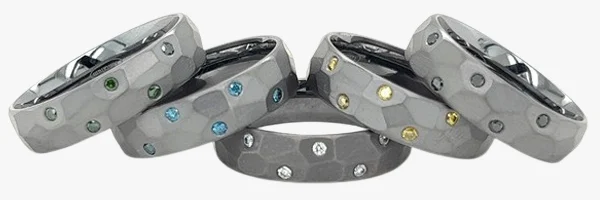
Polished tantalum reflects light softly. Brushed finishes introduce a fine grain that reduces reflectivity. Hammered finishes create controlled surface variation, which can visually soften minor surface marks.
Scratch behaviour in real wear
Tantalum does scratch. Its scratch behaviour is similar to titanium and platinum. It is not brittle like tungsten carbide and does not resist surface marking in the way ceramics do.
Scratches tend to appear as shallow, soft-edged marks. Over time, these blend into a general surface patina. This is expected wear and does not compromise the structure of the ring.
Engraving performance
Tantalum metal engraves extremely well using fibre laser systems. The engraving produces a dark, high-contrast mark that remains legible against the grey metal.
Because tantalum is dense and homogeneous, engraving depth and appearance are consistent. Fine lettering and detailed designs can be achieved without chipping, flaking, or uneven results.
Working with tantalum in the workshop
Manufacturing approach
Tantalum rings are machined and finished using controlled cutting and abrasive processes. The metal is tough and ductile, allowing it to be shaped without fracture. At the same time, it work-hardens under tooling, which requires appropriate speeds and pressure.
Heat is generally avoided during ring manufacture due to the high melting point and the specialised conditions required for welding tantalum metal.
Ring sizing and availability
Tantalum wedding rings cannot be resized after manufacture. This is an industry-wide limitation.
While tantalum metal can technically be cut and rejoined, doing so requires specialist welding equipment, controlled atmospheres, and results in material loss. Given the cost of the metal and the low demand for resizing compared with initial manufacture, this is not commercially realistic for most jewellery workshops.
For this reason, tantalum rings are made to size from the outset. Rings are available in sizes P to Z+3, allowing a wide range of fitting options when sizing is confirmed accurately before manufacture.
Refinishing options
Tantalum can be refinished. Polished and brushed finishes can be restored by removing a small amount of material from the surface. This process is similar in principle to refinishing platinum.
Hammered finishes can be refreshed, although the original texture will influence the final appearance. Refinishing cannot remove deep deformation or significantly alter the ring profile.
Available finishes
Common finishes for tantalum rings include polished, brushed, and hammered. Each finish interacts differently with light and wear.
Polished finishes show marks more readily but can be restored. Brushed finishes diffuse surface marks and develop a softer patina. Hammered finishes tend to disguise everyday wear more effectively due to their irregular surface.
Why tantalum is favoured at the bench
From a workshop perspective, tantalum metal is valued for its predictability. It machines consistently, engraves cleanly, and responds reliably during finishing.
Engraving quality is a particular advantage. Laser engraving on tantalum produces crisp, high-contrast results with minimal variability. This consistency is not always present in lighter alternative metals.
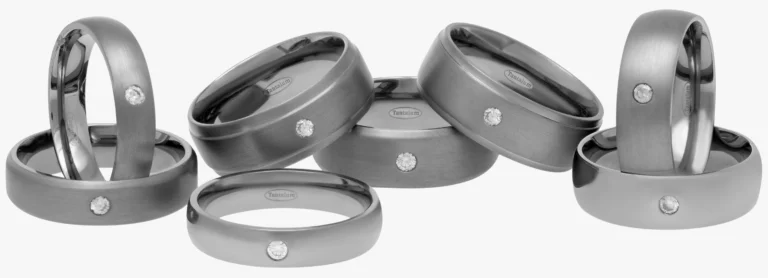
Diamond setting is also more predictable than in some other alternative materials. Tantalum’s toughness and elasticity allow controlled metal movement during setting without brittleness. This makes it suitable for both standard and coloured diamond settings when handled by an experienced setter.
These practical characteristics make tantalum metal a dependable material when precision and repeatability matter.