Free UK Delivery | 30 Days Return Policy

Tungsten Rings Pros and Cons: Technical Guide

Understanding Tungsten Carbide as a Jewellery Material

Understanding Tungsten Carbide as a Jewellery Material

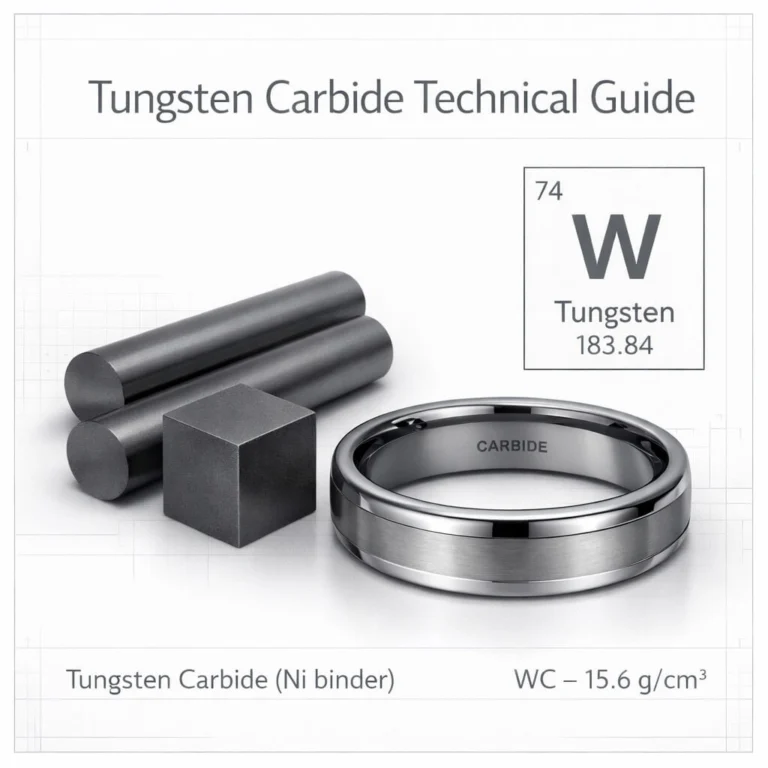
Tungsten carbide entered jewellery relatively late compared with traditional precious metals. Its adoption followed decades of industrial use rather than decorative experimentation. Tungsten carbide is not a pure metal. It is a composite material formed by combining tungsten powder with a metallic binder and consolidating the mixture into a dense, solid structure.

Understanding tungsten rings pros and cons requires this material science context. The behaviour seen on the finger is governed by the same principles that govern performance in industrial applications.

Quick Summary

In jewellery, the composite typically contains between 90 and 97 percent tungsten, with the remaining 3 to 10 percent made up of a binder metal. This binder is most commonly nickel or cobalt. The resulting material behaves more like an advanced engineering ceramic than a conventional metal. It is extremely hard, dimensionally stable, and resistant to surface wear, but it does not deform plastically in the way gold, platinum, or tantalum do.

This material first appeared in jewellery in the late 20th century, driven by developments in powder metallurgy and sintering techniques that made consistent, ring-sized components commercially viable. Its rise coincided with growing interest in alternative materials for wedding rings, particularly among wearers looking for durability, weight, and a neutral industrial appearance.

From a workshop perspective, understanding what this composite is explains both its strengths and its limitations when used for rings. Its behaviour on the finger mirrors its behaviour in industrial environments, where performance is dictated by hardness, compressive strength, and resistance to abrasion rather than ductility.

Material properties in practical terms

The defining characteristic of this material is hardness. On the Mohs scale, it measures between 8.5 and 9. This places it far above gold at 2.5 to 3, titanium at approximately 6, and cobalt alloys at around 5 to 6. Vickers hardness values for jewellery-grade material fall in the range of 1500 to 2000 HV. For comparison, commercially pure titanium measures around 160 HV, while cobalt chrome alloys typically measure between 380 and 450 HV.

These figures illustrate key tungsten rings pros and cons visible in hardness measurements. Extreme surface resistance comes at the cost of ductility.

Density is another relevant property. The composite has a density between 14.5 and 15.5 g/cm³. This makes it significantly heavier than titanium at around 4.5 g/cm³ and broadly comparable to gold alloys, which typically fall around 15.5 g/cm³. Platinum remains heavier at approximately 21.4 g/cm³. In wear, tungsten rings feel substantial without the extreme weight associated with platinum.

The melting point of tungsten as a pure metal is 3422°C, the highest of all elemental metals. Tungsten carbide itself is not melted during manufacture. Instead, it is processed through sintering at temperatures between approximately 1400 and 1600°C. These temperatures are sufficient to bond the tungsten particles through the binder phase without reaching full melting. This explains why tungsten rings cannot be cast, welded, or reshaped once manufactured.

Binder chemistry and long-term behaviour

The binder metal used has a direct impact on corrosion resistance, appearance stability, and skin compatibility. Historically, cobalt was widely used as a binder in industrial cutting tools due to its strength and sintering performance. In jewellery, cobalt binders present two issues. First, cobalt is more susceptible to corrosion and surface discolouration in certain chemical environments. Second, cobalt can present skin sensitivity concerns for some wearers.

Nickel binders address both of these issues. Modern jewellery-grade tungsten carbide rings supplied in the UK and EU are produced using nickel binder systems that comply with EU nickel release regulations. In practice, this means the nickel is locked within the carbide matrix and does not migrate to the surface under normal wear conditions.

From a workshop standpoint, all tungsten rings we engrave and finish use nickel binder formulations. This choice improves resistance to chemical attack, reduces the risk of surface discolouration, and ensures compliance with current regulatory standards.

Industrial context and why it matters

Long before it appeared in jewellery, tungsten carbide was established as a cornerstone in heavy industry. Its dominance in cutting tools, mining equipment, and wear-resistant components is a direct consequence of its mechanical properties.

In metalworking, tungsten carbide cutting inserts are used to machine hardened steel, stainless steel, and titanium at high speeds. The extreme hardness allows cutting edges to remain stable under conditions that would rapidly blunt high-speed steel tools. In mining and drilling, tungsten carbide components are used in rock drill bits and oil and gas exploration equipment, where resistance to abrasion and compressive forces is essential.

The same composite is also used in forming dies, punches, and other wear parts subjected to repeated high loads. In these applications, failure occurs through fracture rather than gradual deformation, which aligns with the ceramic-like behaviour observed in jewellery use.

For jewellery workshops, this industrial background explains why tungsten rings behave predictably during engraving and why they cannot be worked using traditional jeweller’s techniques. Rings arrive as finished components because the same properties that make tungsten carbide invaluable in industry prevent post-manufacture reshaping.


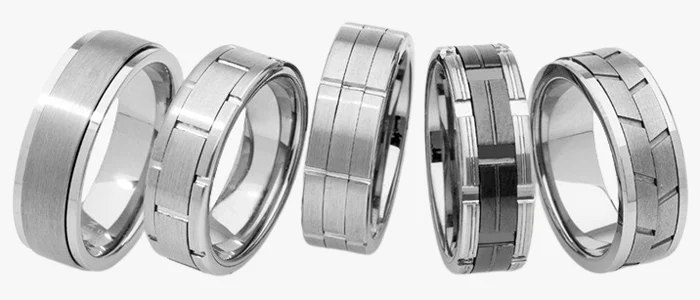
Tungsten Spinner Rings - Tungsten Rings Pros and Cons
A selection of our Tungsten Spinner Rings

Manufacturing methods for rings

Rings made from this composite are produced using powder metallurgy rather than casting or forging. Tungsten powder is mixed with binder powder to achieve the required composition. This mixture is then compacted under high pressure into a ring-shaped form.

The compacted ring is sintered in a controlled atmosphere furnace at temperatures between approximately 1400 and 1600°C. During sintering, the binder phase melts and flows, allowing tungsten particles to bond together and achieve near-full density. The result is a rigid, fully hardened ring blank.

Once sintered, the material is extremely difficult to machine. Conventional cutting tools are ineffective, and any material removal requires diamond abrasives. For this reason, ring dimensions, profiles, and features such as grooves or inlays are determined during manufacturing rather than added later.

In our workshop, tungsten rings arrive from suppliers as finished products. Our work focuses on laser engraving, surface finishing where applicable, and quality inspection rather than structural modification.

Workshop experience and real-world wear

We engrave and polish tungsten rings daily, and we also see rings return after months or years of wear. This exposure provides a clear picture of how the material behaves outside controlled conditions.

Surface wear develops very slowly. Polished finishes retain their reflectivity for extended periods, and brushed finishes maintain their texture far longer than comparable finishes on titanium or precious metals. The material is not scratch-proof, but it is highly scratch resistant. When marks do occur, they are usually the result of contact with materials of similar hardness, such as ceramics or hardened steel.

Impact behaviour highlights further tungsten rings pros and cons. The composite is extremely hard but not tough in the metallurgical sense. It does not bend or absorb shock energy. Under sharp impact, stress concentrates rather than distributing through plastic deformation. In rare circumstances, this can lead to chipping or fracture.

In practice, normal office work, driving, and household activities present little risk. Repeated heavy impacts, dropping the ring onto hard surfaces, or trapping it between rigid objects increase the likelihood of damage. These outcomes reflect material behaviour rather than manufacturing defects.

Chemical resistance and surface stability

The material does not rust and does not oxidise in normal atmospheric conditions. It is resistant to water, sweat, and most common household substances. The binder phase remains the most chemically vulnerable component.

Extended or repeated exposure to strong oxidising agents such as bleach can affect surface appearance over time. Alcohol-based hand sanitisers, when used excessively without rinsing, have also been observed to cause subtle surface changes in some cases. These effects occur through gradual chemical interaction with the binder rather than the tungsten phase itself.

Where chemical exposure is frequent or unavoidable, darker metal alternatives such as tantalum rings may be more suitable. In situations where greater impact tolerance is required, cobalt rings offer different performance characteristics.

Sizing limitations and fitting considerations

Rings made from this material cannot be resized. This is a physical limitation, not a commercial decision. The hardness prevents stretching or compression, and the brittle nature means cutting and rejoining would result in fracture rather than controlled deformation.

This constraint affects all tungsten wedding rings and makes accurate sizing before manufacture essential. Once produced, the size is fixed. Ring width also influences perceived fit and should be considered during sizing.

Engraving behaviour in practice

Internal engraving performs exceptionally well using fibre laser systems. The laser produces a high-contrast dark mark that remains stable and legible over time. The engraving mechanism involves controlled surface modification rather than material removal.

Because the composite is dense and homogeneous, engraving depth and appearance are consistent. Fine lettering and detailed designs reproduce reliably when set up correctly, as outlined in our laser engraving guide.

External engraving is not offered in our workshop. Creating recessed external features introduces stress concentration points at the edges of the engraving, increasing the risk of chipping if the area catches during wear. This is a design decision informed by material behaviour rather than an engraving limitation.

Design, appearance, and finishes

The natural colour is a dark grey that can appear gunmetal under certain lighting. The colour comes from the material itself rather than coatings or surface treatments.

Polished finishes produce high reflectivity and retain that appearance for extended periods due to surface hardness. Brushed finishes create a satin texture that diffuses light and reduces the visibility of minor surface marks. Both finishes maintain defined edges and profiles over time, as the material does not deform under normal wear.

These characteristics underpin the appeal of tungsten wedding rings for wearers who value shape retention and long-term surface stability. Design options in men’s tungsten rings UK collections reflect this approach, relying on manufacturing precision rather than post-production modification.


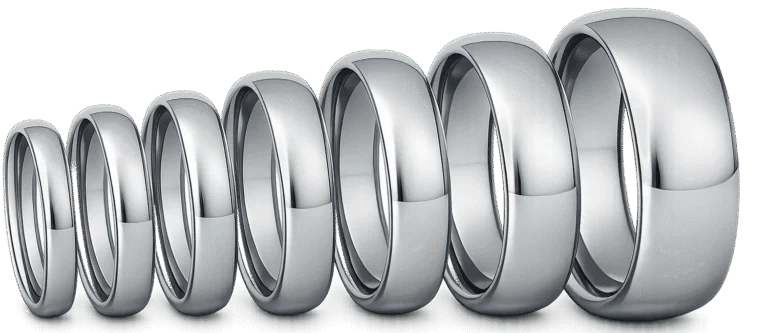
Polished tungsten carbide wedding rings shown in all available widths from 3mm to 10mm
Tungsten Carbide Blended Court Wedding Rings

Tungsten rings vs titanium and other materials

When comparing tungsten rings vs titanium, the differences are pronounced. Titanium is lightweight, ductile, and resilient under impact, but it scratches relatively easily. Tungsten rings are heavier, vastly harder, and retain their finish longer, but they do not absorb shock and cannot be resized. Both materials resist corrosion well, but they suit different priorities.

Compared with tantalum, this composite offers greater scratch resistance and surface stability. Tantalum is tougher and more ductile, allowing refinishing and impact absorption without fracture. Both materials sit in similar weight ranges and share darker grey tones, but their wear patterns differ fundamentally.

Cobalt alloys sit between these materials. They are harder than precious metals but softer than tungsten-based composites. Cobalt is more impact tolerant and can be cut in emergency removal scenarios, whereas tungsten relies on controlled cracking.

Against gold and platinum, the differences are stark. Scratch resistance is vastly higher, weight is comparable to gold, and resizing behaviour is entirely different. These contrasts reinforce that tungsten rings are not substitutes for precious metals, but distinct options with their own performance profiles.

Emergency removal considerations

Traditional ring cutting tools are ineffective. The hardness resists saw blades, and attempting to cut the ring would damage the tool before penetrating the band.

Emergency protocols for tungsten rings rely on controlled cracking. Specialist tools apply concentrated pressure at a specific point, causing the brittle structure to fracture cleanly. When performed correctly, the ring breaks without crushing the finger. This method is standard practice for emergency services.

Guarantee and policy framework

Rings are covered by a standard 2-year manufacturing guarantee that applies to defects in materials or workmanship.

In addition, a one-time accidental damage replacement policy applies on a like-for-like basis. Replacement is limited strictly to the same ring, size, finish, and engraving. This policy reflects confidence in manufacturing consistency while recognising the material’s behaviour under abnormal conditions.

Understanding performance in use

The material offers clear advantages in scratch resistance, shape retention, and long-term surface stability. Its limitations are equally clear. It cannot be resized, it behaves in a brittle manner under sharp impact, and its performance is closely tied to binder chemistry and manufacturing quality.

Understanding tungsten rings pros and cons in these terms allows realistic expectations to be set. Suitability depends on lifestyle and priorities rather than assumptions about durability.

UK Based Stock

We dispatch directly from our Kent Location.

Fast Dispatch

Stock orders placed by 1pm usually sent same working day

Easy Returns

30 day no quibble refund or exchange policy

Expert Support

Speak to our Goldsmith with over 35 years jewellery experience