Damascus steel properties relevant to jewellery
Composition and alloy selection
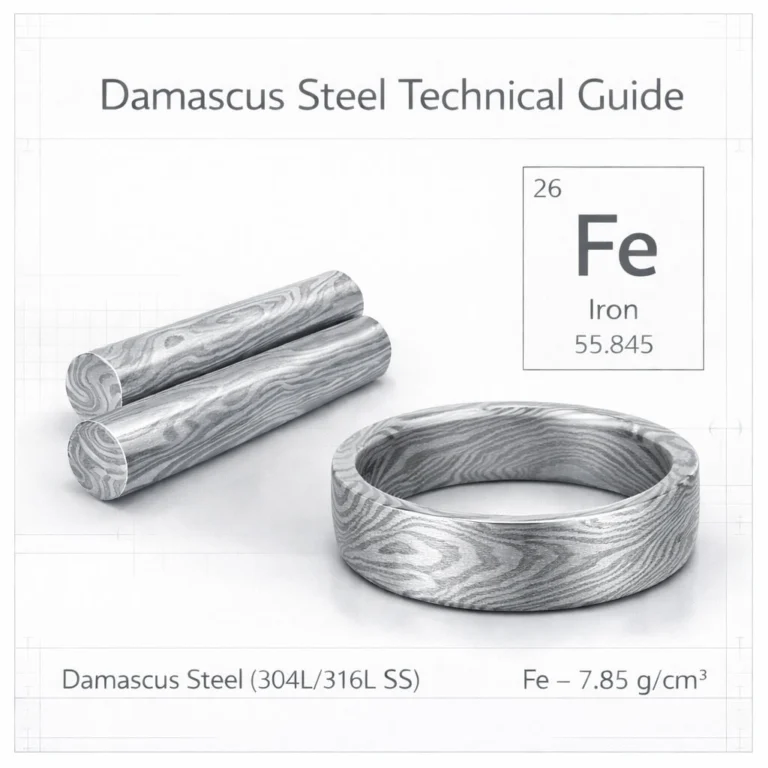
Modern Damascus rings use alternating layers of 304L and 316L stainless steel. These alloys are selected not for decorative effect alone but for regulatory, mechanical, and chemical stability in prolonged skin contact.
Traditional Damascus steel often uses carbon steel combinations. Carbon steels can release nickel above regulatory thresholds when worn against skin for extended periods. For jewellery intended for continuous wear in the UK and EU, stainless steel alloys such as 304L and 316L are required to meet nickel-directive standards.
304L stainless steel is a low-carbon austenitic alloy. The “L” designation indicates reduced carbon content, improving weldability and corrosion resistance. It is widely used in architectural cladding, food-grade equipment, and domestic stainless applications.
316L stainless steel contains molybdenum, increasing resistance to corrosion in saline and acidic environments. It is commonly used in medical implants, surgical instruments, marine hardware, and high-end watch cases. Its stability makes it suitable for prolonged skin contact.
When layered together, 304L and 316L provide a combination of weld strength, corrosion resistance, and visual contrast after etching. The resulting material conforms to UK and EU jewellery standards while maintaining the layered aesthetic associated with Damascus steel.
Hypoallergenic behaviour
The use of 304L and 316L stainless steel results in hypoallergenic behaviour suitable for prolonged wear. Both alloys are widely used in medical and consumer applications where skin contact is continuous. Their layered combination does not alter their regulatory compliance, as the material remains stainless steel throughout its structure.
Mechanical properties
Damascus steel rings produced from stainless steel exhibit mechanical behaviour typical of austenitic stainless alloys. The material is ductile rather than brittle, allowing it to absorb deformation rather than fracture under extreme force. However, the layered structure introduces welded interfaces that behave differently from homogeneous metals under stress.
The forge-welded bonds between layers are structurally sound under normal wear but can be affected by extreme shear forces. This characteristic is central to the resizing limitations discussed later in this guide.
Pattern formation
The visual pattern in Damascus steel is not a surface decoration but a structural feature created by layered alloys. After forging and shaping, the surface is chemically etched. During etching, 304L erodes slightly faster than 316L, creating microscopic differences in height across the surface. These differences produce contrast between lighter raised areas and darker recessed areas, revealing the layered structure.
Because the pattern exists throughout the depth of the material, it remains visible even after surface finishing or light refinishing.
Damascus steel for jewellery and ring design
Design structures and surface treatments
Four distinct ring designs are produced using the same underlying material system but different pattern manipulation and surface treatments.
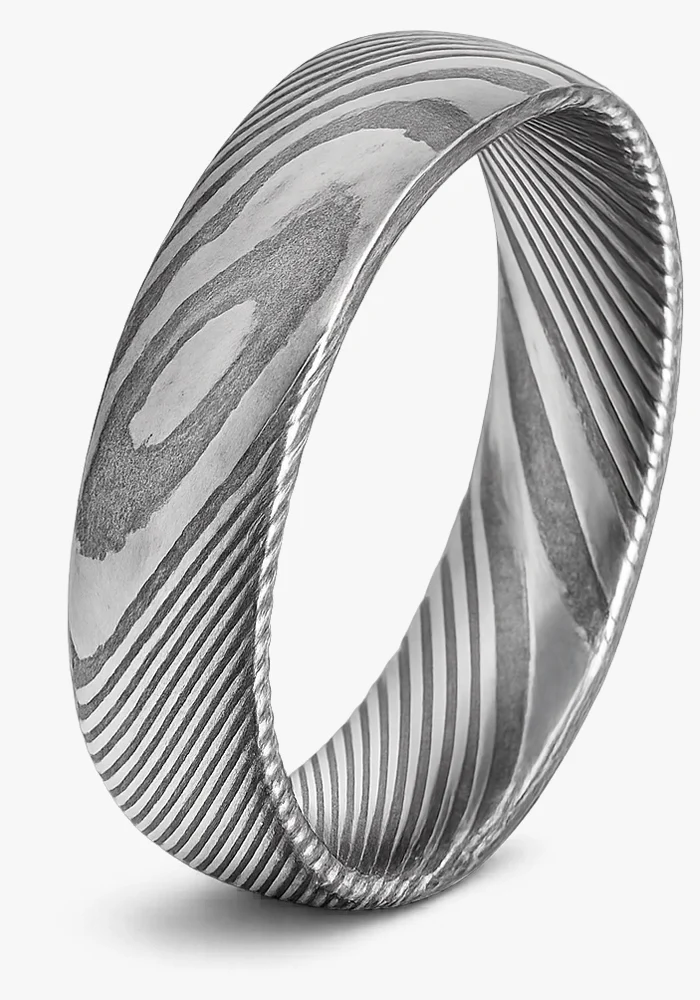
The Woodgrain Damascus ring uses 304L and 316L stainless steel without any applied coating. The pattern resembles flowing organic lines similar to wood grain. Contrast is produced solely by etching, with the layered structure visible on both the exterior and interior surfaces. Because no coating is present, this design offers the clearest visual contrast between layers.
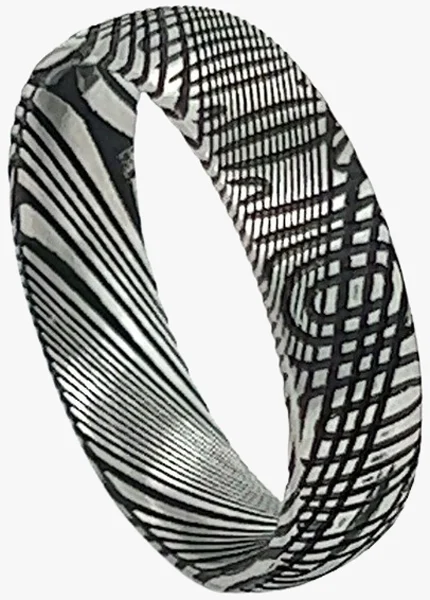
The Tribal Damascus ring uses the same layered stainless steel but incorporates a black PVD coating. The pattern consists of intersecting ovals and abstract lines with deeper grooves, creating a textured surface with pronounced relief.
The Circles Damascus ring also uses black PVD coating but features swirling circular patterns. Compared to the Tribal design, the surface is smoother, with softer transitions between pattern elements.
The Reticulated Damascus ring is wider and deeper than the other designs. It features a bold dimpled texture and irregular surface geometry. The layered structure remains present beneath the black PVD coating, but the surface topography is more pronounced.
All designs use a court profile with a curved interior and are manufactured to final size.
Pattern variability
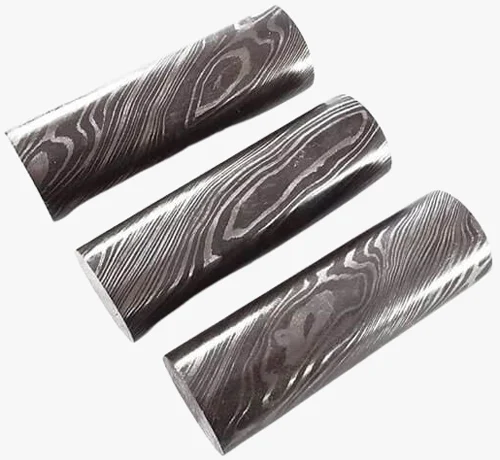
The pattern in each ring is influenced by the orientation of the billet during lathing. Billets are cylindrical or rectangular blocks of layered steel from which ring blanks are cut. When a ring blank is lathed from a billet, the cross-section exposed depends on the position and orientation of the cut.
Larger ring sizes are cut from different sections of the billet than smaller sizes. As a result, the visible pattern varies across rings, even within the same design. No two rings display identical patterns, and variations can occur even between rings of the same size and style.
This variability is a structural consequence of pattern welding rather than a surface effect.
Engraving on Damascus steel
Laser engraving on Damascus steel is possible but behaves differently from engraving on single-alloy metals.
The alternating layers of 304L and 316L respond differently to laser energy. Variations in thermal conductivity and reflectivity affect how deeply the laser penetrates each layer, resulting in inconsistent depth and contrast.