Free UK Delivery | 30 Days Return Policy

Black Zirconia Ceramic Technical Reference Guide

What is Black Zirconia Ceramic?

What is Black Zirconia Ceramic?

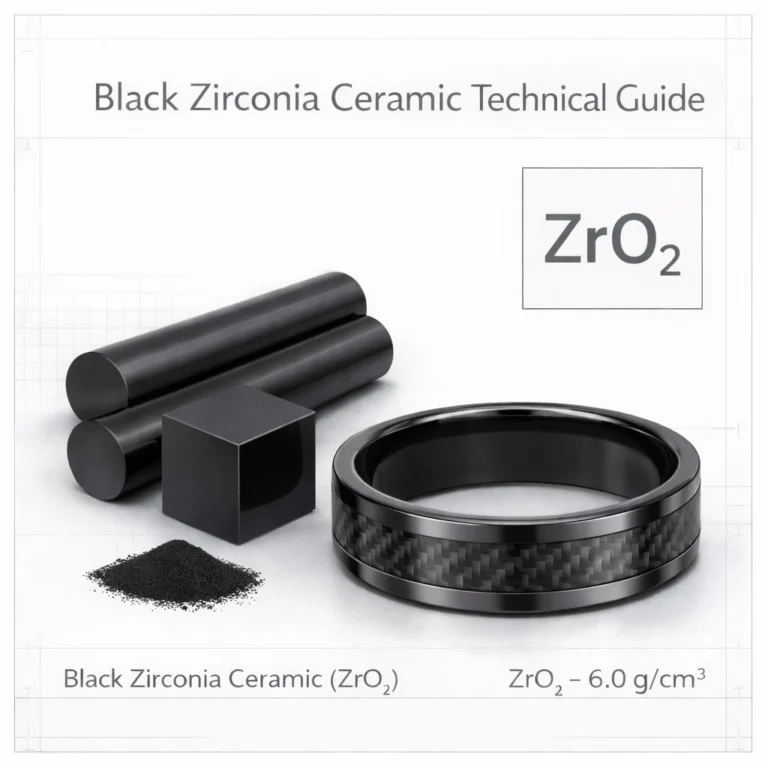
Black zirconia ceramic is a technical ceramic based on zirconium dioxide, with the chemical formula ZrOâ‚‚. Despite the similarity in name, this material is not zirconium metal. It is a non-metallic material with physical, mechanical, and thermal behaviour that differs fundamentally from metals commonly used in jewellery.

Zirconia occurs naturally within mineral ores, but it does not exist in nature as a finished ceramic. For engineering and jewellery use, zirconium dioxide is refined into a fine powder and processed into dense components through controlled high-temperature sintering. The resulting ceramic behaves very differently from metallic materials.

Quick Summary

Black zirconia ceramic is black all the way through its structure. The colour is intrinsic to the ceramic body and is not applied as a surface treatment, coating, plating, or PVD layer. This distinction is important when comparing ceramic rings with surface-treated black metal rings, where colour is created by coatings over a lighter metal substrate.

Before being used for jewellery, the material has a long history in industrial and medical applications. Its adoption for black rings and zirconia wedding bands reflects the transfer of high-performance engineering ceramics into wearable form rather than decorative finishes applied to conventional metals.

Understanding what this ceramic is, and what it is not, provides the foundation for realistic expectations around wear behaviour, durability, and design trade-offs. For a practical overview, see our black zirconia ceramic pros and cons guide.

The zirconia ceramic material and its industrial context

Zirconia ceramic is defined by very high surface hardness, chemical inertness, thermal stability, and electrical insulation. These properties explain why the material has been used in demanding industrial environments long before being adapted for jewellery.

In aerospace and motorsport applications, including Formula 1, the ceramic is used in engineered components such as thermal barrier coatings, insulating parts, bearings, and wear components. These applications rely on the material’s ability to remain dimensionally stable under extreme temperatures and mechanical stress. They involve precision-engineered components rather than bulk ceramic forms analogous to jewellery rings.

Medical applications represent another major area where this ceramic is widely used. Zirconia-based materials are found in hip joint components, dental implants, and prosthetics. Their bioinert behaviour, resistance to corrosion, and long-term stability within the human body make them suitable for prolonged implantation.

The material is also used in industrial cutting tools and wear parts, where abrasion resistance and high compressive strength are required. These uses demonstrate why it is selected when predictable performance and chemical stability are prioritised over ductility.

This industrial background explains the performance characteristics that zirconia ceramic brings when adapted for jewellery applications such as black ceramic wedding rings and bands.

Zirconia ceramic properties relevant to jewellery

Composition and stabilisation

Ceramics of this type are typically stabilised using small amounts of yttria. Yttria stabilisation improves phase stability and toughness, reducing the risk of uncontrolled cracking. This approach is common across technical and medical ceramics, although exact formulations vary by supplier.

Regardless of stabilisation method, the material remains non-metallic, with no ductility and no capacity for plastic deformation.

Hardness and surface behaviour

Zirconia ceramic exhibits very high surface hardness. Depending on formulation and processing, its hardness is comparable to or exceeds many tungsten carbide formulations when assessed using Vickers hardness testing. On the Mohs scale, values typically fall around 8.5 to 9.

This high surface hardness explains the exceptional resistance to micro-abrasion seen in black ceramic rings. Everyday contact with keys, door handles, desk surfaces, and household objects does not readily produce visible scratches. Only materials harder than the ceramic, such as diamond, sapphire, or certain advanced carbides, are capable of scratching it under normal conditions.

Hardness and toughness are distinct properties. While the ceramic strongly resists surface scratching, it does not deform under load in the way metals do.

Toughness and failure mode

The material has high compressive strength but relatively low tensile toughness compared with metals. It has no ductility. Under sufficient point impact or concentrated stress, it can chip or fracture rather than bend.

This brittle failure mode is characteristic of ceramics. It does not indicate fragility in normal wear, but it defines the limits under extreme force.

Density and weight

The density is approximately 6.0 g/cm³. This places it heavier than titanium at around 4.5 g/cm³, but significantly lighter than tungsten carbide at approximately 15.6 g/cm³ and tantalum at about 16.6 g/cm³.

In practical terms, black zirconia ceramic rings have noticeable presence without the substantial weight associated with very dense metals.

Thermal and electrical properties

The ceramic is both a thermal and electrical insulator. Unlike metals, it does not readily conduct heat or electricity, contributing to a neutral feel against the skin across different temperatures.

The melting point is extremely high, in the region of 2700°C. While irrelevant to daily wear, this helps explain the material’s thermal stability during manufacture and use.

Chemical stability and biocompatibility

The ceramic is chemically inert under normal conditions. It does not corrode, tarnish, or react with water, sweat, or common household substances. This bioinert behaviour underpins its widespread use in medical implants.


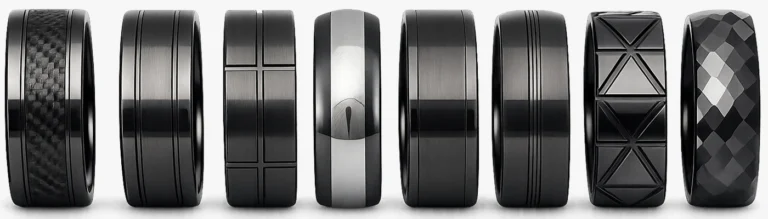
8 Black Zirconia Ceramic Rings standing upright in a line to show our range of black wedding rings

Zirconia ceramic for jewellery and ring design

Why zirconia ceramic works for rings

Black zirconia ceramic occupies a distinct position among materials used for black rings. It offers colour-through consistency, very high scratch resistance, and long-term chemical stability without relying on surface coatings.

Unlike black zirconium or black tungsten, where colour is created by oxide layers or coatings, the ceramic remains black throughout the entire material. If surface damage occurs, no contrasting metal colour is revealed beneath.

These characteristics have made zirconia wedding bands and black ceramic rings for men a recognised option among those researching alternatives to traditional precious metals.

Appearance and finishes

The material has a deep, uniform black appearance. Polished finishes produce a reflective surface with crisp highlights. Brushed finishes introduce fine linear texture that diffuses reflections.

Both finishes affect appearance rather than performance.

Scratch behaviour in real wear

Surface scratching on these rings is uncommon in everyday wear. Micro-abrasion that would quickly mark most metals typically leaves no visible effect on the ceramic surface.

Because the colour runs through the entire ceramic body, any surface damage does not reveal a different underlying colour, unlike plated or oxidised black metal rings.

Engraving considerations

Laser engraving is technically possible using appropriate equipment. However, engraving quality and consistency are less predictable than on metals such as titanium, tungsten carbide, or tantalum.

This is due to the material’s extreme hardness and low thermal conductivity, which affect how laser energy is absorbed and dissipated. As a result, engraving depth, edge definition, and contrast vary more than is acceptable under the quality standards applied here. For this reason, engraving is not offered on zirconia ceramic rings.

Working with zirconia ceramic in the workshop context

Manufacturing overview

Components are produced by sintering zirconium dioxide powder at very high temperatures, typically exceeding 1400°C, under controlled conditions. During sintering, powder particles bond at a molecular level, eliminating porosity and forming a dense, uniform ceramic body.

Stabilising agents such as yttria are incorporated to control phase behaviour and improve toughness. The resulting structure is crystalline and exhibits the high hardness, chemical stability, and wear resistance characteristic of technical ceramics.

Once sintered, the ceramic cannot be worked using conventional metalworking techniques. Shaping and finishing require diamond abrasives and specialised processes.

Ring sizing and availability

Rings of this type cannot be resized after manufacture. This is an absolute limitation of the material. Ceramic cannot be stretched, compressed, or reformed like metal.

Rings are manufactured to final size, making accurate sizing essential. Sizes are available from J to Z+11. An exchange policy exists to address sizing issues, reflecting inherent material limitations.

Refinishing options

Surface refinishing is possible but limited. Polished finishes can be restored through careful abrasive polishing. Brushed finishes can be refreshed.

Structural damage such as chips or fractures cannot be repaired. Ceramic cannot be flowed, welded, or reshaped once damaged.

Wear, damage, and real-world behaviour

Surface wear

Under normal wear conditions, black zirconia ceramic rings show minimal visible wear. High surface hardness prevents micro-abrasion from most everyday contacts.

Impact behaviour

Under extreme point impact, the ceramic can chip or fracture rather than dent. This contrasts with metals, which deform plastically under similar conditions.

Such impacts are uncommon in daily wear but possible in high-energy situations. Ring width and wall thickness play a more significant role in ceramic structural integrity than in many metals.

Trade-offs

The material offers exceptional resistance to surface wear with lower tolerance for extreme impact compared with ductile metals. Understanding this balance allows informed material selection.


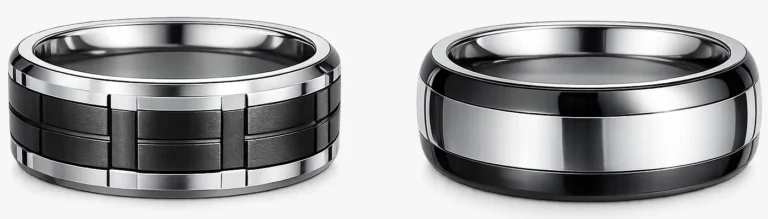
Two men's tungsten carbide and black zirconia ceramic wedding rings side by side
Tungsten Carbide with Black Zirconia Ceramic

Zirconia ceramic compared to other materials

Zirconia ceramic vs tungsten carbide

Both materials offer very high surface hardness and cannot be resized. Zirconia ceramic is significantly lighter.

Hardness levels are comparable depending on binder content. The ceramic remains black throughout, while black tungsten typically relies on surface coatings that can reveal lighter metal beneath if damaged.

Zirconia ceramic vs black zirconium metal

Zirconia ceramic and black zirconium metal are fundamentally different. Ceramic is non-metallic and colour-through. Black zirconium relies on an oxide layer over metallic zirconium.

If scratched, the ceramic remains black. Black zirconium can reveal silver metal beneath the oxide. Zirconium metal dents under impact. Ceramic fractures.

Zirconia ceramic vs Titanium

Titanium is lightweight and tough but scratches readily. The ceramic is far more resistant to surface wear but less forgiving under impact.

Titanium deforms. Ceramic fractures.

Zirconia ceramic vs black tungsten

Black tungsten relies on surface treatments for colour. Damage can expose lighter metal beneath. The ceramic remains black throughout the material.

Both materials cannot be resized and exhibit brittle behaviour, though fracture mechanisms differ.

Wear and refinishing expectations

Black zirconia ceramic rings maintain their appearance exceptionally well under normal wear. Limited surface refinishing is possible. Structural damage cannot be repaired.

Black zirconia ceramic is a high-performance material with clear strengths and defined limitations. When chosen with these characteristics in mind, it offers long-term colour stability and surface durability that clearly distinguishes it from plated or coated black metal rings.

UK Based Stock

We dispatch directly from our Kent Location.

Fast Dispatch

Stock orders placed by 1pm usually sent same working day

Easy Returns

30 day no quibble refund or exchange policy

Expert Support

Speak to our Goldsmith with over 35 years jewellery experience