Free UK Delivery | 30 Days Return Policy

Tungsten Carbide Wedding Rings Buyers Guide

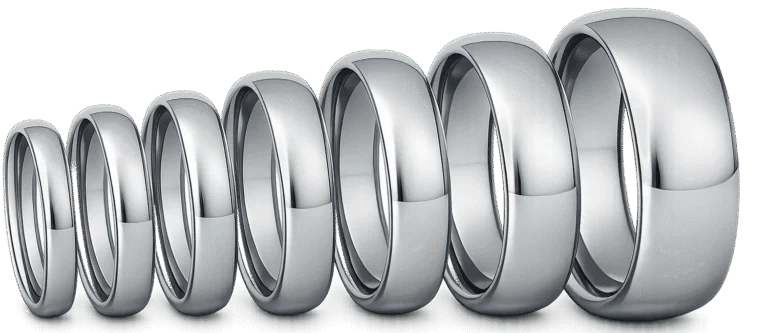
Polished tungsten carbide wedding rings shown in all available widths from 3mm to 10mm
Quick Summary

Why choose tungsten carbide wedding rings

Working with tungsten rings every day quickly shows how differently this material behaves compared with traditional jewellery metals. Engraving, finishing, and occasionally replacing rings that have been worn for years provides a clear picture of how tungsten carbide performs outside technical descriptions.

Tungsten carbide wedding rings are not made from a pure metal. They are a composite material formed by combining tungsten particles with a small percentage of metallic binder and consolidating the mixture into a dense solid through high-temperature sintering.

Hardness defines the material. The composite resists surface wear to a degree that most metals cannot approach. Once manufactured it also remains dimensionally stable, which is why the shape and edges of the ring change very little over time.

At the same time it behaves more like an engineering ceramic than a ductile metal. It does not bend, cannot be resized, and reacts differently under impact.

Understanding those characteristics makes choosing tungsten carbide wedding rings much easier.

Quick summary

Tungsten carbide wedding rings are extremely hard and highly scratch resistant. Polished finishes keep their appearance for far longer than most jewellery metals.

That hardness also explains the main limitation. Tungsten rings do not bend or stretch, so resizing is impossible and sharp impacts can occasionally cause chipping.

Most people researching tungsten rings pros and cons are simply deciding which of those characteristics matters more for their lifestyle.

Readers who want the full metallurgy behind the material can explore it in the tungsten carbide technical guide.


What makes tungsten carbide different

Most jewellery metals share a common trait. They are ductile.

Gold, platinum, and titanium can flex slightly under pressure, which is why jewellers can resize or reshape them when necessary.

Tungsten behaves very differently.

The composite structure is formed from tungsten particles bonded together with a metallic binder. That structure creates a very dense and extremely rigid material.

Hardness is the first property most people notice. On the Mohs scale it sits between roughly 8.5 and 9. Gold alloys normally fall around 2.5 to 3, while titanium sits close to 6. Even harder jewellery alloys such as cobalt chrome rarely exceed 6.

This gap explains tungsten ring scratch resistance. Materials that would quickly mark precious metals often leave tungsten rings largely unchanged.

Weight is another immediately noticeable characteristic. With density between roughly 14.5 and 15.5 grams per cubic centimetre, tungsten carbide feels similar in weight to a gold ring while being far heavier than titanium.

Pick one up and the difference is obvious. Customers who expect an alternative metal ring to feel light often pause for a moment when they first handle tungsten rings because the weight feels familiar, closer to traditional precious metal rings.

Jewellery-grade tungsten carbide uses nickel binder systems rather than cobalt binders. The nickel remains locked within the carbide matrix and complies with EU nickel release regulations.

In practice the material is suitable for prolonged skin contact while retaining its mechanical properties.


How tungsten carbide rings are made

Tungsten carbide rings are not cast or forged like precious metal rings.

Manufacture relies on powder metallurgy.

Tungsten powder is blended with binder powder and compacted under pressure into a ring-shaped blank. The compact then enters a furnace where temperatures reach roughly 1400 to 1600°C.

During sintering the binder phase melts and flows between the tungsten particles, bonding them together into a dense solid structure.

Once this stage finishes it is already fully hardened.

Machining tungsten carbide requires diamond abrasives, so rings are manufactured to their final dimensions during production rather than altered afterwards.

That manufacturing process explains why resizing is impossible.

Sizing accuracy therefore matters. Wider rings cover more surface area on the finger and often feel tighter than narrow rings of the same size.

Most tungsten rings are produced with a comfort-fit interior, meaning the inside edge is slightly curved rather than flat. This helps wider bands slide over the knuckle more easily and improves comfort once worn.

Even with a comfort-fit interior, width still influences sizing. Someone measured at size M using a narrow gauge may prefer half a size larger when ordering an 8mm band.

Getting this right before ordering makes a real difference.


Tungsten ring scratch resistance in daily wear

Durability at the surface is the reason many people choose tungsten rings.

Polished tungsten carbide wedding rings keep their reflectivity for long periods. Precious metals gradually develop fine scratches that soften the surface. The material resists this process because it is extremely hard.

Brushed finishes behave in a similar way. The satin grain created during finishing tends to remain visible even after extended use.

Experience with returned rings highlights the difference clearly. Rings worn daily for several years often show remarkably little change to the finish.

That durability is exactly why mens tungsten rings UK customers rely on the finish holding up through daily wear.

The material is not scratch-proof.

Materials with comparable hardness such as ceramics, hardened steels, or other carbide surfaces can still mark the ring if contact occurs under pressure.

For everyday activities such as office work, driving, or typical household tasks, visible wear is usually minimal. That is why tungsten ring durability is one of the material’s main advantages.



 

Engraving on Tungsten Carbide

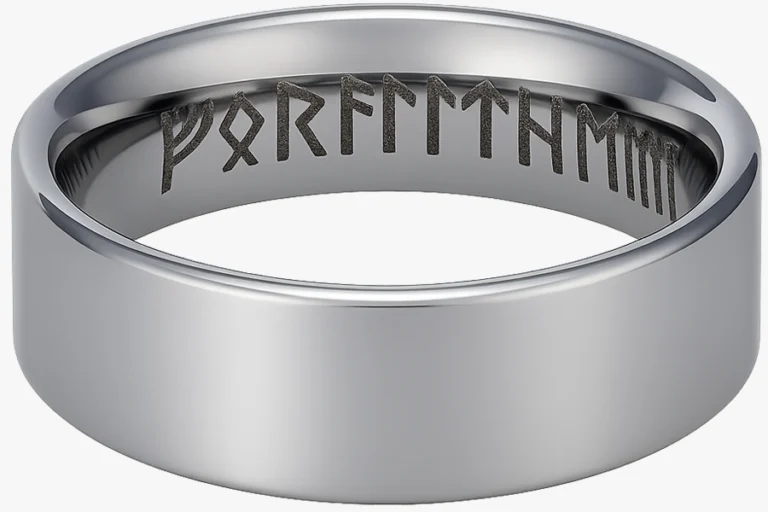
Internal engraving performs exceptionally well using fibre laser equipment. The laser produces a dark mark through controlled surface vaporisation rather than cutting or removing material, which is one reason results are so consistent on tungsten carbide.

In day-to-day workshop use, tungsten tends to engrave with very uniform contrast across different finishes. Titanium can vary more, with the final tone affected by surface finish and heat response, so the same artwork may not look identical across two titanium rings in the way it usually does on tungsten.

Because the material is dense and consistent, fine lettering and detailed designs reproduce reliably when the artwork and settings are matched correctly.

Further explanation of the process can be found in the laser engraving guide.

External engraving is not offered. Recessed markings on the outer surface create stress concentration points that increase the likelihood of chipping if the area catches during wear.


Tungsten carbide ring weight and feel

Weight becomes most noticeable once tungsten rings have been worn for a while.

Unlike very light materials, tungsten maintains a steady presence on the finger throughout the day. Many wearers describe it as feeling solid and reassuring rather than barely noticeable.

Over time the weight simply becomes normal.

People who initially notice the density often say that after a few days they stop thinking about it entirely. What remains is the sense that the ring feels stable and substantial.

For many wearers that quiet sense of permanence is part of the appeal.


Tungsten carbide ring limitations

Hardness brings advantages, but it also shapes the limitations of tungsten carbide.

Because the material does not flex, resizing is not possible. The structure cannot stretch or compress in a controlled way.

The same rigidity explains how it responds to impact. Instead of bending under stress, tungsten concentrates the force. In rare situations a sharp impact may cause chipping or fracture.

Across years of engraving and handling these rings, actual breakage from ordinary daily wear is uncommon. When damaged rings do return, there is almost always a specific incident involved such as dropping the ring onto concrete or trapping it against a hard surface.

Chemical exposure can influence appearance over long periods. Tungsten carbide itself is stable, but the metallic binder phase can react slowly with strong oxidising agents. Repeated exposure to bleach or heavy use of alcohol-based hand sanitisers without rinsing may lead to subtle surface changes.

Emergency removal procedures are different as well. Standard ring cutters are ineffective against tungsten carbide rings. Emergency services instead use specialised tools designed to apply concentrated pressure to the band, causing it to fracture cleanly without compressing the finger.

All tungsten carbide rings supplied are covered by a standard 2-year manufacturing guarantee against defects in materials or workmanship.

Within that same period the first instance of accidental damage is replaced on a like-for-like basis with the same design, size, finish, and engraving.


If tungsten carbide is not quite right for you

For many people tungsten rings work extremely well.

Wearers who spend most of their working day indoors, prefer a ring with noticeable weight, and want a surface that keeps its appearance for years often find tungsten wedding rings an ideal choice.

Some lifestyles benefit from a different metal.

Tantalum rings provide a darker grey appearance and greater ductility. They absorb shock more easily and can be refinished if the surface becomes worn.

Cobalt rings sit between precious metals and tungsten in behaviour. They remain harder than gold or silver while tolerating impact more readily than tungsten carbide.

Occasionally someone working in heavy mechanical environments replaces a damaged tungsten ring with cobalt or tantalum. Matching the material to the wearer usually resolves the issue.


Tungsten carbide ring designs and finishes

Tungsten carbide has a natural dark grey colour that can appear slightly gunmetal depending on lighting conditions.

No plating or coatings are required to produce that appearance.

Polished finishes create a bright reflective surface. Brushed finishes produce a satin texture that softens reflections and helps disguise minor marks.

Widths generally range from 3mm to 10mm, covering both narrow and wider band styles.

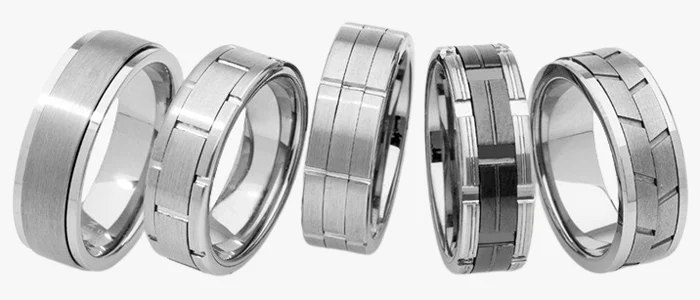
Several profiles are available within that range, including court and flat designs in both polished and brushed finishes, along with comfort-fit variations. Inlay rings featuring bevelled chamfered edges are also available, as well as traditional shapes such as blended court rings.

Spinner rings with a rotating centre band offer an interactive alternative for wearers who want something different.

Narrower widths with traditional court profiles remain a common choice, while wider flat designs are often selected for a more contemporary look.

The full range of tungsten wedding rings can be explored on the tungsten rings page.

Tungsten Spinner Rings - Tungsten Rings Pros and Cons

Summary

If you are considering tungsten carbide for a wedding ring, the key question is simple.

Do you want a ring that keeps its finish for years and feels solid on the finger?

Tungsten carbide wedding rings excel at both. The surface resists scratching, the shape remains stable, and the weight gives the ring a reassuring presence.

The trade-off is rigidity. Resizing is not possible and the material reacts differently to sharp impacts than softer metals.

When the tungsten rings pros and cons match the wearer’s lifestyle, tungsten wedding rings tend to perform exactly as expected.

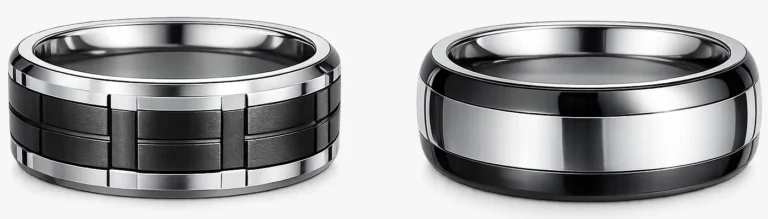
Two men's tungsten carbide and black zirconia ceramic wedding rings side by side
UK Based Stock

We dispatch directly from our Kent Location.

Fast Dispatch

Stock orders placed by 1pm usually sent same working day

Easy Returns

30 day no quibble refund or exchange policy

Expert Support

Speak to our Goldsmith with over 35 years jewellery experience