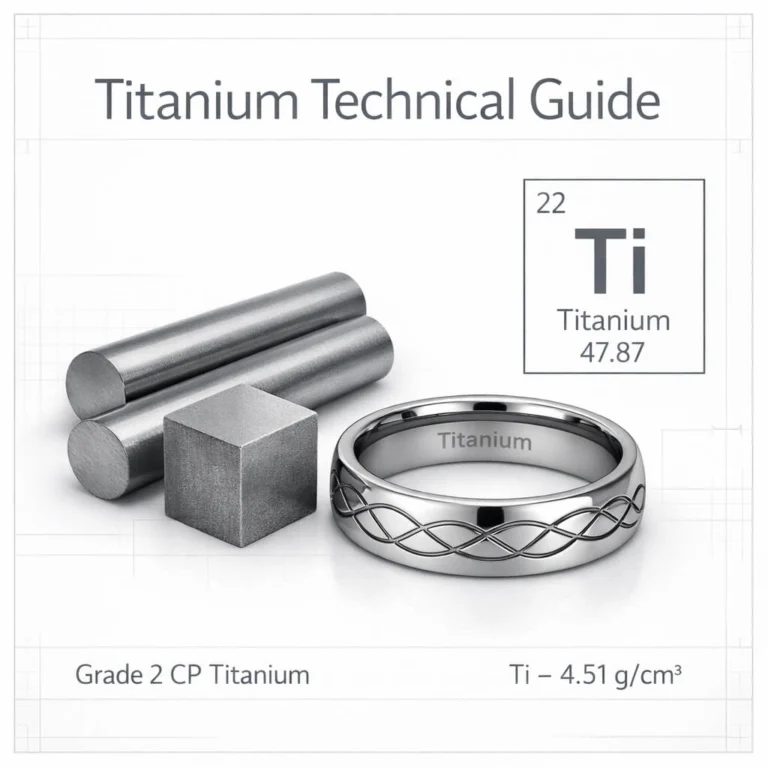
Grade 2 titanium specifications
Most Grade 2 titanium rings are manufactured from commercially pure titanium, widely used in medical, aerospace, and industrial applications because it balances strength, corrosion resistance, and machinability better than higher-alloyed grades.
Elemental composition, typical for Grade 2 commercially pure titanium:
Titanium: approximately 99 percent
Oxygen: up to 0.25 percent
Iron: up to 0.30 percent
Carbon, nitrogen, hydrogen: trace limits
Mechanical and physical properties of Grade 2 titanium:
Mohs hardness: approximately 6
Vickers hardness: approximately 160 HV
Tensile strength: approximately 345 MPa
Yield strength: approximately 275 MPa
Specific gravity: approximately 4.51 g/cm³
For context, gold alloys typically sit around 2.5 to 3 on the Mohs scale, while platinum alloys are around 4 to 4.5. Titanium is harder than most precious metals, but it still behaves as a metal surface rather than a ceramic.
Comparison with precious metals
| Property | Titanium (Grade 2) | 18ct Gold | Platinum |
|---|
| Mohs hardness | approx. 6 | 2.5 to 3 | 4 to 4.5 |
| Specific gravity | 4.51 | approx. 15.5 | approx. 21.5 |
| Relative weight | 1× | approx. 3.4× | approx. 4.8× |
| Tensile strength | approx. 345 MPa | approx. 130 MPa | approx. 125 to 200 MPa |
| Biocompatible | Yes | Alloy-dependent | Yes |
This comparison highlights titanium’s performance characteristics relative to traditional precious metals. The material offers significantly higher strength at a fraction of the weight, while surface behaviour differs from softer alloys.
Biocompatibility and surgical implant use
Grade 2 titanium is classed as biocompatible and is widely used in surgical implants. It is nickel-free and does not rely on alloying elements that commonly cause skin reactions.
Titanium is one of the few materials that human bone will actively bond to, a process known as osseointegration. Bone cells attach directly to the titanium surface rather than merely tolerating it as a foreign object.
This property is why:
Hip replacements use titanium components and commonly remain functional for 20 years or more
Dental implants are screwed directly into jawbone and bond permanently
Pacemaker cases are made from titanium to protect electronics inside the body for decades without immune response
This biocompatibility explains why Grade 2 titanium rings are suitable for prolonged skin contact under normal wear conditions.
Relevant material standards include ASTM F67 and ISO 5832-2 for unalloyed titanium used in surgical implant applications. Jewellery is not certified as a medical device, but the underlying material specification is the same.
Wear characteristics in everyday use
Titanium rings develop surface marks during everyday wear in the same way as gold, platinum, and silver. Scratches and scuffs are cosmetic changes and do not indicate weakness or degradation.
Titanium does not flake, delaminate, or shed surface layers. Surface marks are displaced metal rather than coating failure. Understanding this distinction is important from a durability perspective.
In over 24 years of workshop handling, Grade 2 titanium rings do not snap, fracture, or fail structurally in normal use. The material combines high tensile strength with toughness, meaning it resists cracking rather than breaking suddenly.
Deformation under extreme force is possible, such as industrial crushing or vehicle collision, as with any metal ring. Brittle failure is not characteristic of titanium.
Weight, feel, and thermal behaviour
Titanium is exceptionally light for its strength. By volume, it is as strong as steel while being around 45 percent lighter. In tensile strength terms, it is roughly ten times stronger than 18ct gold.
A practical comparison illustrates this clearly. A 6 mm wide titanium wedding ring weighs approximately the same as a 2 mm gold band. This low mass affects daily wear comfort, particularly for wider bands.
Titanium also has low thermal conductivity compared with precious metals. It does not feel as cold when first worn, reaches body temperature quickly, and remains more comfortable in cold environments.
These characteristics explain why titanium dominates applications where mass reduction without strength compromise is critical. Examples include:
The SR-71 Blackbird, constructed largely from titanium to withstand Mach 3+ speeds and extreme surface temperatures
Modern fighter aircraft, where titanium forms a major proportion of structural mass
Formula 1, where titanium exhaust systems, suspension components, and fasteners reduce weight without loss of strength
Space launch vehicles, where titanium components survive extreme heat and mechanical stress
The same low density explains why titanium rings feel noticeably lighter on the hand, even at wider widths.
Sizing limitations
Titanium rings are not economically resizable in most cases. The labour involved in cutting, re-machining, welding, and refinishing typically exceeds the cost of manufacturing a replacement ring.
Minor size adjustment is technically possible in some designs. Stretching or compressing by approximately one UK size up or down may be achievable, depending on ring width, wall thickness, and profile. Beyond this range, dimensional control and surface finish are compromised.
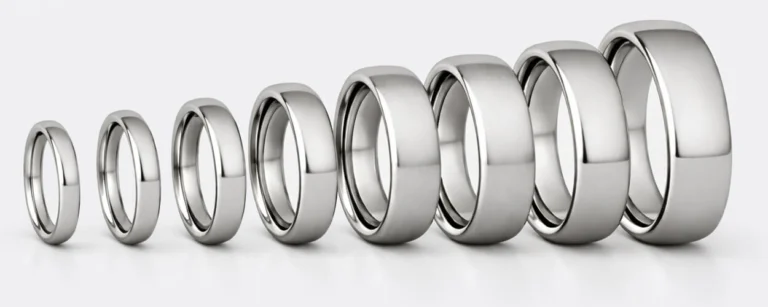
For this reason, titanium rings are best supplied in a wide size range at manufacture. Stocking sizes from H through Z+6 avoids reliance on later adjustment. Accurate sizing before manufacture is essential, as outlined in the ring size guide.
Engraving properties
Laser engraving titanium produces exceptional results. The laser creates a dark, high-contrast mark caused by controlled surface oxidation rather than material removal.
Key engraving characteristics include crisp edges, high legibility, and excellent contrast without requiring engraving depth. This behaviour is relied upon in laser engraving on titanium rings.
Titanium can also be anodised to produce colour through controlled oxide layer thickness. This can be achieved using a laser engraving system by adjusting voltage and process settings. Colour is determined by voltage rather than dye.
Typical anodising voltage to colour reference:
Colour consistency is more difficult to control than black laser engraving. Small variations in surface condition, geometry, or voltage can affect the final colour.
Stone setting behaviour
Titanium rings can accept stones using an invisible pressure-setting technique. A precisely sized hole is drilled into the ring, the stone is pressed into the opening, and the surrounding titanium is burnished to compress over the stone girdle. The stone sits flush with the ring surface without claws or bezels.
Based on workshop experience, only diamond, sapphire, and ruby are suitable for this method. Stones such as emerald, amethyst, or topaz, while reasonably hard, are more brittle and frequently crack under the compressive force required to achieve a secure seat.
This setting method requires perfectly calibrated stones. Drill diameter and stone girdle size must match exactly. Even small dimensional errors prevent secure seating or cause stone damage.
Refinishing and repair considerations
Titanium rings can be repolished or refinished to remove surface marks within reason. Material removal must be carefully controlled to preserve geometry and dimensional accuracy.
From a cost perspective, labour time is the dominant factor. Material cost is low, but refinishing can exceed the original ring price. This reflects workshop economics rather than any inherent limitation of the metal.
Chemical resistance and durability
Titanium is chemically inert in normal environments. It is unaffected by seawater, sweat, skin oils, chlorine at domestic concentrations, and most household and industrial chemicals.
The protective oxide layer reforms in nanoseconds, even when scratched underwater. This behaviour is relied upon in naval applications, including titanium-hulled submarines, and in chemical processing plants handling acids, alkalis, and chlorine that rapidly attack stainless steel.
Titanium does not tarnish, patinate, or discolour over time.
Emergency removal
Titanium rings can be removed safely in emergency situations. Standard steel ring cutters are effective when used with two opposing cuts. Diamond cutting discs provide faster removal.
No specialist equipment is required, and controlled cutting does not pose the same challenges as ceramic-based materials.
Manufacturing methods and workshop challenges
Grade 2 titanium rings are typically produced by CNC machining and precision lathe work. From a workshop perspective, titanium is significantly more difficult to work with than precious metals.
The material work-hardens during cutting, generates heat rapidly, dulls tools faster than steel, and exhibits galling during thread cutting. Titanium cannot be traditionally cast due to its high melting point of approximately 1668 °C and cannot be forged like gold or silver.
During finishing, titanium produces visible sparks when belt-brushed or aggressively abraded. This is a reliable workshop indicator that distinguishes titanium from precious metals and stainless steel.
Despite these challenges, CNC and lathe machining offer key advantages. Tight dimensional tolerances, consistent wall thickness, accurate sizing, and repeatable surface finishes are achievable. This level of control is essential for engraving accuracy, stone-setting compatibility, and long-term consistency.
Understanding titanium performance characteristics
Titanium performance is defined by strength, weight, and chemical stability rather than surface hardness. The material offers exceptional strength-to-weight performance, proven biocompatibility, excellent engraving behaviour, and long-term resistance to corrosion.
The practical limitations are equally clear. Titanium shows surface wear in everyday use, resizing is limited and often impractical, and refinishing can be labour-intensive. These characteristics reflect the material’s industrial origins.
Understanding titanium’s material properties allows realistic expectations based on material science. For practical buying guidance and comparisons, see our titanium rings pros and cons guide.