What Is Damascus Steel?
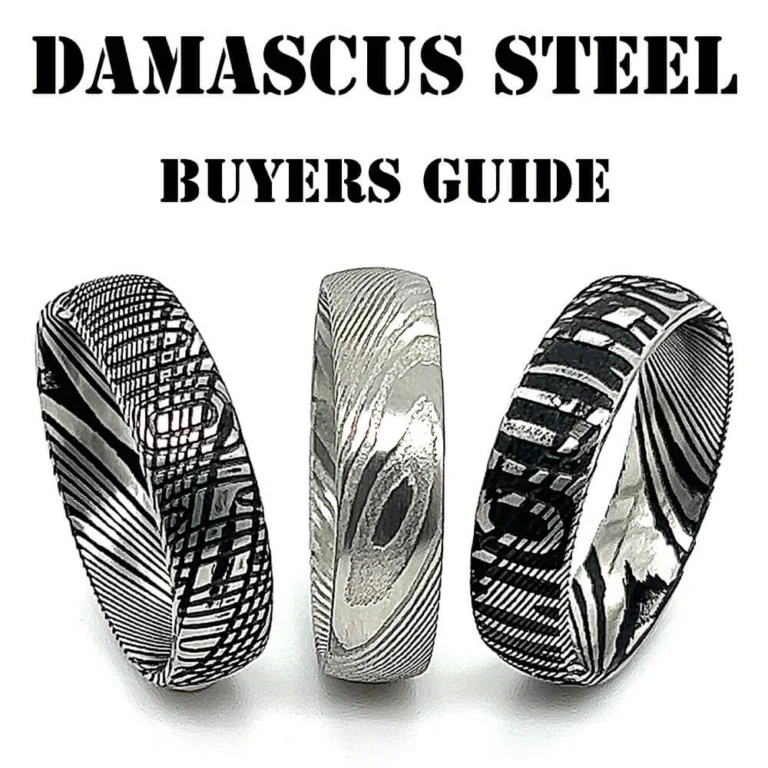
Damascus steel is created by stacking multiple layers of steel and forge-welding them into a single solid billet under heat and pressure. The billet is then twisted, folded, or compressed to produce flowing lines, waves, or organic patterns before being cut and formed into a ring.
Because the pattern is created by the layered structure of the metal itself, it runs through the full thickness of the ring. It is not etched, printed, or coated onto the surface, and it cannot wear away independently of the metal.
Historic Damascus steel varied by region and smith, and many early techniques are no longer used today. Modern Damascus used for rings relies on stainless steel alloys selected for stability, corrosion resistance, and suitability for prolonged skin contact.
Why Damascus Steel Works Well in Rings
Damascus steel rings offer characteristics that single-alloy rings cannot replicate:
• Natural pattern variation created during forging
• Visual depth that changes with light and viewing angle
• Solid construction formed from a single forged billet
• Court-shaped interiors for comfortable daily wear
• Stainless steel base suitable for long-term skin contact
Because the material is forged rather than cast, the structure is consistent throughout the band. There are no internal voids, bonded layers, or surface films that can separate over time. This distinguishes hand-forged Damascus rings from imitation patterned rings that rely on surface treatments or laminated shells.
These qualities make Damascus steel rings popular as men’s wedding bands for those who prefer visible craft and material depth rather than high polish.
Are Damascus Steel Rings Suitable for Everyday Wear?
Damascus steel rings made from 304L and 316L stainless steel are suitable for everyday wear. These alloys are stable, corrosion resistant, and designed for long-term skin contact.
Routine wear may gradually soften raised areas of the pattern, particularly on black finishes, but this does not affect the structural integrity of the ring. The layered pattern remains part of the metal itself.
Why We Do Not Use Carbon Steel
Many Damascus rings sold internationally are made from carbon steel. While visually striking, carbon steel presents several problems for jewellery use.
Carbon steel can react with moisture and skin acidity, leading to rust, staining, or surface discolouration. Over time, this can affect both appearance and wearability.
More importantly, carbon steel may release nickel at levels that exceed UK and EU limits for jewellery worn against the skin. In the UK and EU, jewellery must comply with strict nickel-release regulations. For this reason, carbon steel is not appropriate for rings intended for daily wear.
We do not use carbon steel in any Damascus steel rings.
The Stainless Steels We Use: 304L and 316L
All Titan Jewellery Damascus steel rings are forged using 304L and 316L stainless steel.
The “L” designation refers to low carbon content, which improves weld stability and corrosion resistance during the high-temperature forging process.
304L stainless steel
Commonly used in food preparation equipment and architectural applications. It is tough, stable, and suitable for skin contact.
316L stainless steel
Used in medical devices, surgical instruments, marine hardware, and watch cases. The addition of molybdenum improves resistance to salt, moisture, and acidic environments.
When layered together in Damascus forging, these alloys produce a material that is:
• Compliant with UK and EU jewellery regulations
• Resistant to corrosion and moisture
• Stable for everyday wear
• Suitable for sensitive skin
These materials are used exclusively and are never substituted.
Black Damascus Steel and PVD Finishing
Stainless steel does not darken reliably through acid or heat treatments. To achieve a black finish safely, black Damascus steel rings are finished using PVD coating.
PVD, or Physical Vapour Deposition, is a vacuum-based process in which a thin coating is bonded to the surface of the metal. It is widely used in medical devices, aerospace components, and watchmaking.
The coating follows the contours of the forged Damascus pattern beneath. Over time, raised areas may lighten slightly while recessed areas retain deeper colour. The underlying layered steel remains visible throughout the life of the ring.
PVD allows black Damascus steel rings to be produced without using carbon steel and without compromising skin safety.
Can Damascus Steel Rings Be Resized?
Damascus steel rings cannot be resized in the same way as traditional precious metals. The forged stainless steel structure does not allow stretching or compressing without damaging the layered pattern.
In some cases, the internal diameter can be bored out to increase the size slightly, typically by up to half a UK size. Reducing the size is not possible without removing and reworking material, which would disrupt the pattern.
Accurate sizing at the point of order is therefore important.
Choosing a Damascus Steel Ring Style
All Damascus steel rings share the same layered stainless steel construction. Differences between styles are primarily visual and tactile.
Patterns with smoother surfaces and lighter contrast offer more predictable results if engraving is requested. Designs with deeper grooves emphasise texture and contrast but reduce engraving clarity. Black finishes increase visual depth, while natural stainless finishes show the layering more evenly across the band.
Damascus Steel Ring Styles
Woodgrain Damascus Steel Ring
This design features flowing, organic lines similar to natural woodgrain. It is finished in natural stainless steel without a surface coating.
Because there is no black finish, this style offers the clearest contrast between layers and the most predictable results for engraving.
Tribal Damascus Steel Ring
The Tribal design uses intersecting oval and abstract shapes cut into the surface of the ring. The grooves are deeper and more pronounced, creating a rugged, tactile texture.
The ring is finished with black PVD to emphasise contrast between raised and recessed areas.
Circles Damascus Steel Ring
This design features softer, swirling circular patterns with a more fluid appearance. The surface is less angular than the Tribal style but still shows strong pattern depth.
Black PVD is used to highlight the layered structure beneath.
Reticulated Damascus Steel Ring
The Reticulated style is the widest and deepest profile in the range. It features an irregular, dimpled surface with a raw, sculpted appearance.
Finished in black PVD, the texture develops subtle visual changes over time as raised areas soften through wear. This design is intended as a bold statement ring.
Summary
Damascus steel rings combine layered construction, visible craft, and regulated materials. By using 304L and 316L stainless steel and avoiding carbon steel entirely, these rings meet UK and EU standards while retaining the distinctive patterns that define Damascus steel.
Each ring is forged from solid material, not assembled from layers or treated for appearance alone. The result is a ring with permanent patterning, structural consistency, and suitability for everyday wear.






 Winner of King award for Alternative Metal Rings
 Winner of Theo Paphitis (Dragons Den) Small Business Award
 We are fully pci-dss compliant
 Security Headers rate us A+ for website security
 We are registered with the ico for data protection
 We are members of The Guild of Jewellery Designers